There is no single machine that works best for every material or application. The right laser cleaner is not simply the model with the highest power rating. It is the machine that removes the rust efficiently while protecting the underlying material.
For steel structures, industrial machinery, thick steel plates and large areas of heavy rust, a 1000W to 2000W continuous-wave laser cleaner is usually the more practical choice. It delivers higher throughput and a lower processing cost per square metre on large, robust steel surfaces.
For automotive body panels, moulds, precision components, aluminium alloys and other surfaces that require more careful treatment, a 200W to 500W pulsed laser cleaner is generally safer. Its controlled energy delivery helps reduce heat build-up, distortion and surface discolouration.
The table below provides a simple starting point:
Main Application | Recommended Machine | Why It Fits |
|---|---|---|
Light rust on tools and components | 100W–300W pulsed laser cleaner | Precise cleaning with limited heat input |
Automotive panels and thin sheet metal | 200W–500W pulsed laser cleaner | Reduces the risk of distortion and surface damage |
Moulds and precision components | 200W–500W pulsed laser cleaner | Better control over cleaning depth and finish |
Steel structures and industrial machinery | 1000W–1500W CW laser cleaner | Faster cleaning across larger working areas |
Thick steel, pipelines and shipbuilding | 1500W–3000W CW laser cleaner | Better suited to heavy rust and high-volume work |
Automated production lines | High-power CW or robotic system | Stable and repeatable cleaning |
LaserCleanerPro follows the same application-first approach. Rather than offering one machine for every job, its current range covers 100W to 3000W, including portable backpack systems, handheld cleaners, pulsed precision machines and water-cooled continuous-wave systems for heavy industrial work. The range is divided into five series so buyers can select equipment according to material, contamination level, mobility and required daily output.
Why Is There No Single Best Laser Cleaner for Every Rust Removal Job?
Different users define a successful cleaning result in different ways.
When laser cleaning a large steel structure, productivity is often the main concern. As long as the process does not significantly damage the steel, faster cleaning normally means lower labour costs and greater daily output.
The requirements are very different when cleaning a car door, a precision mould or a finished mechanical component. Removing the rust is only part of the job. If the workpiece becomes distorted, discoloured or loses its original texture and dimensions, the cleaning result may still be unacceptable.
A suitable laser cleaner must therefore achieve two things: it must remove the contamination, and it must preserve the condition and value of the workpiece.
This is why more power does not always produce a better result.
A 1500W continuous-wave laser cleaner may remove rust from thick steel plate quickly, but it can introduce too much heat into a thin automotive panel if the settings are not controlled properly. A 300W pulsed laser cleaner may produce excellent results on moulds and detailed parts, but it may be too slow for large structural steel projects.
The best choice is the machine that provides the right balance of cleaning speed, surface quality and total operating cost.
Pulsed or Continuous-Wave: Which Type Is Better?
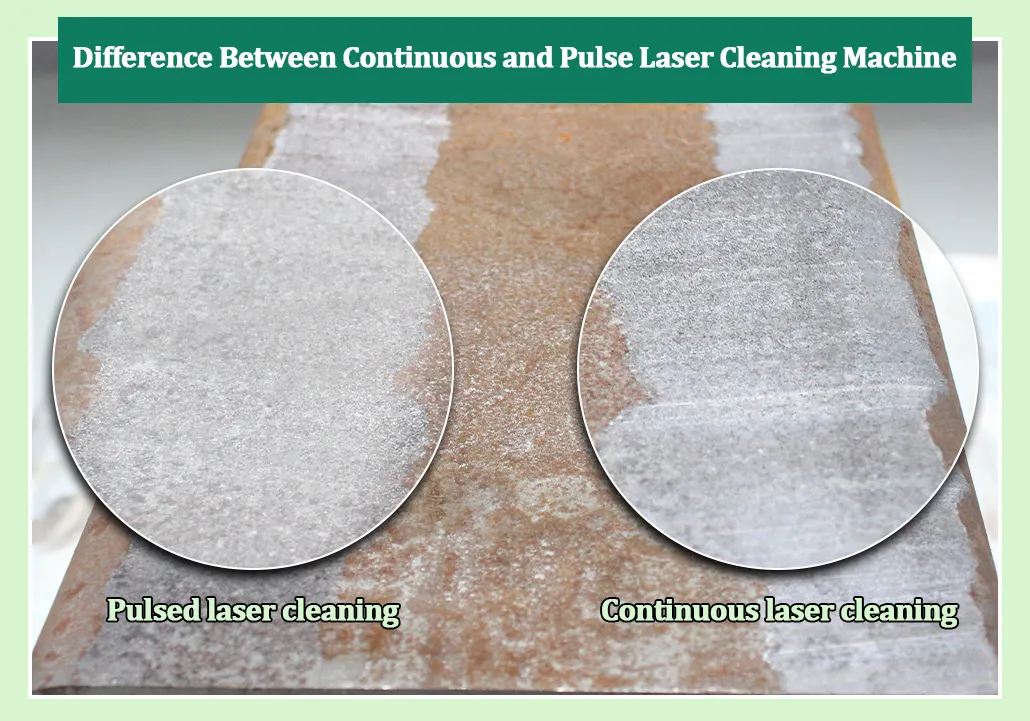
Both pulsed and continuous-wave lasers can remove rust, but they deliver energy to the surface differently. This affects their cleaning speed, heat input and suitable applications.
Pulsed Laser Cleaners Prioritise Surface Control
A pulsed laser releases energy in a series of extremely short, high-energy pulses rather than continuously heating the workpiece.
The rust or oxide layer absorbs the energy and rapidly expands, cracks and separates from the surface. Because there are short intervals between pulses, the material has more time to release heat before the next pulse arrives.
As a result, pulsed laser cleaning generally produces less heat build-up in the substrate. This makes it particularly useful for automotive bodywork, precision moulds, aluminium, copper, detailed components and other surfaces where excessive heat could affect the final result.
The operator can also adjust the pulse settings, frequency and scanning width to suit the workpiece. This provides better control around edges, threads, recesses and complex geometry.
LaserCleanerPro’s pulsed platform covers 100W to 500W. Its LY series is designed for applications such as thin rust, oxide, mould residue, aluminium parts and selective coating removal, where preserving the substrate matters more than achieving the highest possible square-metre-per-hour figure.
The main advantage of a pulsed laser is not maximum speed. It is controlled cleaning.
The disadvantage is that pulsed machines normally cost more per watt and may take longer to process large areas of heavy corrosion.
Continuous-Wave Laser Cleaners Prioritise Throughput
A continuous-wave, or CW, laser delivers a steady stream of energy to the surface. It removes rust through sustained heating, ablation and vaporisation.
Because the energy acts continuously, CW laser cleaners can usually process thick carbon steel, structural components, pipes, storage tanks and heavy machinery more quickly than low-power pulsed systems.
For large working areas and applications where output is the main priority, continuous-wave technology normally offers a stronger cost-to-throughput ratio.
However, a CW laser introduces more continuous heat into the material. If the power, scanning speed or focal distance is not set correctly, or if the cleaning head remains over one area for too long, the surface may become overheated, discoloured or distorted.
LaserCleanerPro offers water-cooled CW platforms from 1000W to 3000W for heavy rust, mill scale, thick coatings and large steel surfaces. These systems are intended for applications such as fabrication, steel structures, shipyards and high-volume surface preparation, where continuous working capacity is more important than delicate surface control.
Continuous-wave cleaning is therefore not automatically better. It is better when the material is robust enough and productivity is the main requirement.
What Laser Power Is Best for Rust Removal?
The correct power should be selected according to the actual application. The first question should not be “Which machine has the highest wattage?” It should be:
“What materials, rust conditions and working areas will I clean most often?”
100W to 300W Pulsed Laser Cleaners
This power range is mainly used for light rust, thin oxide, oil, paint residue and precision surface cleaning.
It is suitable for tools, mechanical parts, automotive panels, small moulds, stainless steel components and aluminium parts. For users working on relatively small areas and who are particularly concerned about substrate damage, a 200W or 300W pulsed laser cleaner is often sufficient.
The main value of this power range is not rapid cleaning across large steel surfaces. It is the ability to produce a clean, even and controlled result.
LaserCleanerPro provides portable solutions in this range, including backpack and handheld formats. These are intended for field service, mobile cleaning, detailed parts and jobs where the machine needs to be taken to the workpiece rather than installed permanently in one location.
For small-batch precision work, purchasing an oversized CW machine may increase both the investment and the risk of heat-related damage.
500W Pulsed Laser Cleaners
A 500W pulsed laser cleaner provides more productivity while retaining the controlled energy delivery associated with pulsed technology.
It is suitable for automotive restoration, medium-volume mould cleaning, precision component maintenance, stainless steel oxide removal and applications where a consistent surface finish is important.
For businesses that find a 200W or 300W pulsed machine too slow but cannot accept the greater heat input of a CW laser, a 500W pulsed system can provide a practical middle ground.
LaserCleanerPro’s LY100-500W platform covers this requirement. The system combines an air-cooled pulsed laser with an adjustable handheld scanning head, allowing the operator to narrow the working area for detailed components or increase the scan width for larger flat surfaces.
The higher purchase price is justified mainly when the workpieces are valuable, the required finish is strict or the daily workload makes a lower-power unit too slow.
1000W to 1500W Continuous-Wave Laser Cleaners
This is one of the most practical power ranges for general industrial rust removal.
A 1000W or 1500W CW laser cleaning machine can be used on structural frames, fabricated components, machinery, pipes, tanks and surfaces that need to be cleaned before welding or coating.
For many fabrication shops, maintenance companies and mobile industrial contractors, a 1500W CW laser cleaner offers a strong balance between cleaning speed, equipment cost and usability.
It is faster than a low-power pulsed system on large steel surfaces, while remaining easier to operate and more affordable than many 3000W industrial configurations.
LaserCleanerPro’s HW continuous-wave platform starts at 1000W, while its LCW water-cooled series starts at 1500W. This allows buyers to choose between mixed industrial work at the lower end and sustained heavy-rust removal at higher power levels.
For businesses mainly cleaning ordinary steel with moderate to heavy corrosion, 1000W to 1500W is often a sensible starting range.
2000W to 3000W Continuous-Wave Laser Cleaners
This power range is designed for heavy rust, large steel surfaces and extended industrial operation.
Typical applications include shipbuilding, railway maintenance, oil and gas pipelines, heavy machinery, bridge steelwork and automated surface-treatment lines.
Higher power can increase cleaning capacity, but a 3000W machine will not always clean twice as fast as a 1500W model.
Actual productivity depends on the cleaning head, scanning width, beam quality, rust thickness, workpiece geometry and process settings. If these factors are not properly matched, increasing wattage alone may not provide a proportional increase in output.
LaserCleanerPro’s LCW1500-3000W and HW1000-3000W systems are water-cooled and designed for heavy rust and large-surface applications. The LCW series is positioned for sustained high-volume cleaning, while the HW range offers a broader starting power for steel structures, shipyards and mixed heavy-duty work.
These machines are most appropriate when the cleaning area is large, the workload is already clear and continuous operation is required.
Which Laser Cleaner Is Best for Different Applications?
Automotive Restoration
For car doors, wings, roofs and other thin body panels, a 200W to 500W pulsed laser cleaning machine is normally the safer choice.
Automotive sheet metal is relatively thin, and sustained heat can cause local distortion. Pulsed laser cleaning limits heat accumulation, making it easier to preserve the original shape and surface condition.
If the work mainly involves chassis components, axles, frames and other heavy structural parts, a 1000W to 1500W CW laser cleaner will normally provide better productivity.
Automotive buyers should therefore distinguish between thin-panel restoration and heavy chassis cleaning rather than choosing a machine simply because it is described as suitable for automotive rust removal.
Moulds and Precision Components
Moulds, gears, bearings, precision tools and finished mechanical parts are generally better suited to 200W to 500W pulsed laser cleaners.
These workpieces often have strict dimensional and surface-texture requirements. Excessive heat or uncontrolled material removal may affect assembly, machining accuracy or final product quality.
For high-value components, reducing the risk of damage is often more important than maximising cleaning area per hour.
Fabrication Shops and Machinery Maintenance
For weld preparation, structural steel cleaning, machinery maintenance and general industrial servicing, a 1000W to 1500W CW laser cleaner is usually more practical.
The materials used in these applications are normally thicker and less sensitive to moderate heat input. At the same time, the work often requires higher throughput, allowing the productivity advantages of CW cleaning to become more valuable.
A low-power pulsed machine may still remove the rust, but it could require significantly more operating time, increasing labour costs and reducing daily capacity.
Shipbuilding, Pipelines and Heavy Industry
For ship plates, pipelines, bridges, large steel structures and heavy machinery, a 1500W to 3000W CW laser cleaner is generally more appropriate.
These applications involve larger surfaces, heavier contamination and a stronger focus on continuous output.
When the workpiece dimensions are consistent and the same cleaning process is repeated throughout the day, a robotic or fixed automated system may also be considered. Automation helps maintain a stable cleaning path, speed and working distance across repeated parts.
Why Should You Not Rely Only on Advertised Cleaning Speed?
Many laser cleaning machines are promoted using a square-metre-per-hour figure. However, without clear test conditions, this number has limited value when evaluating actual rust remove performance.
The same machine may remove light surface rust quickly but require slower scanning or several passes when dealing with deep corrosion, thick oxide, mill scale, or a mixture of paint and rust.
The base material also affects performance. Thick carbon steel can generally tolerate greater energy input, while thin sheet metal, aluminium and precision components require more conservative settings.
Scan width is another important factor. A wider scanning pattern may cover more surface area, but if the energy is spread too thinly, the contamination may not be removed completely in one pass.
When a supplier provides a cleaning-speed figure, ask what material was tested, how severe the rust was, what scan width was used, and what surface standard was achieved.
A speed figure is only meaningful when the test conditions are similar to your actual rust remove application.
LaserCleanerPro therefore recommends confirming cleaning speed with a representative customer sample, as the material, rust thickness, coating type, laser power and scan width can all affect the final result.
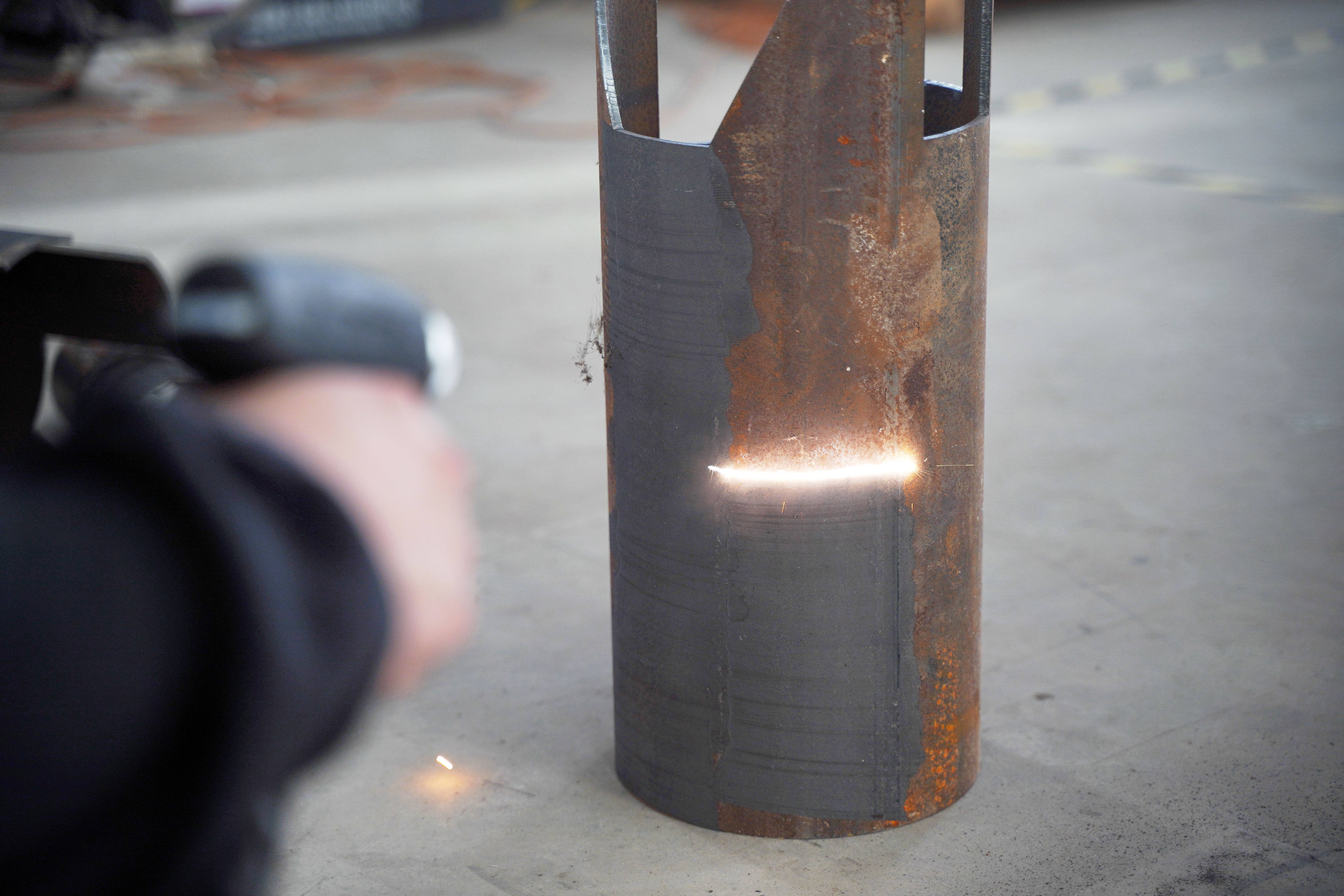
Why Should You Test Your Actual Workpiece Before Buying?
A specification sheet can describe the machine’s configuration, but it cannot prove that the equipment is suitable for your parts.
The most reliable way to evaluate a laser rust remover is to ask the supplier to test an actual workpiece or representative sample.
Provide the material type, thickness, rust condition, approximate cleaning area, required finish and expected daily workload. The supplier should use this information to recommend the laser type and power rather than automatically suggesting the most expensive machine.
The test video should show the machine power, laser mode, scan width, cleaning time and final surface condition. For thin sheet metal and precision components, check whether there is any visible distortion, burning, discolouration or change to the original texture.
This is a key part of LaserCleanerPro’s sales and engineering process. Its Wuhan-based team handles engineering, assembly and application testing, and customers can send their cleaning requirements or samples before placing an order. The goal is to confirm the machine configuration and realistic result on the customer’s own application rather than relying only on a general demonstration.
A real sample test is more useful than comparing wattage and quotations alone.
What Else Should You Confirm Before Buying?
A formal quotation should clearly state the laser type, rated output power, laser source brand, cleaning-head model, cooling method, fibre length and warranty coverage.
It is particularly important not to compare the peak power of a pulsed laser directly with the rated output of a continuous-wave laser.
A pulsed laser can generate very high peak energy for an extremely short period, but this does not mean it has the same sustained cleaning capacity as a CW laser with the same numerical power rating.
The cooling method also affects how the machine can be used. Air-cooled equipment is normally lighter and easier to move, making it suitable for portable or intermittent work. High-power CW cleaners generally use water cooling and are better suited to extended industrial operation.
Safety must also be considered. Laser cleaning machines are high-power Class 4 laser systems. Operators need protective eyewear matched to the laser wavelength, emergency-stop controls, suitable warning signs, controlled working areas and any required safety interlocks.
Laser cleaning does not make contamination disappear. Rust, paint and coatings are converted into fumes and fine particles during the process, so an appropriate extraction system is still required.
Finally, confirm whether the supplier can provide practical after-sales support. LaserCleanerPro states that its machines are supplied with technical support, remote troubleshooting, spare-parts assistance and warranty terms confirmed in writing on the quotation.
A lower purchase price may not produce a lower total cost if parts, process guidance or technical support are difficult to obtain.
About LaserCleanerPro
LaserCleanerPro is an engineering-driven laser cleaning machine manufacturer based in Wuhan. Its product range includes pulsed and continuous-wave systems from 100W to 3000W, covering portable field-service machines, precision pulsed cleaners and high-power industrial platforms.
The brand focuses on matching the machine to the application rather than recommending the same configuration to every buyer. Customers can provide their material, contamination type and expected workload so the engineering team can recommend a suitable platform and carry out application testing before the final configuration is confirmed.
This makes LaserCleanerPro particularly relevant to buyers who need more than a machine specification. The selection process also considers how the machine will be used, how long it needs to operate, what surface quality must be achieved and whether the customer requires a portable, workshop or industrial production system.
Conclusion
For light rust, thin sheet metal, precision parts and high-value surfaces, a 200W to 500W pulsed laser cleaner is usually the better choice. Its main advantage is controlled cleaning with less heat transferred into the underlying material.
For steel structures, industrial machinery, pipelines and general industrial rust removal, a 1000W to 1500W continuous-wave laser cleaner normally provides the best balance of speed, cost and usability.
For large areas of heavy rust, thick steel and continuous production, a 2000W to 3000W CW laser cleaner or an automated laser cleaning system may be more suitable.
Do not choose a machine based only on wattage, and do not rely entirely on advertised cleaning speeds.
The best laser cleaner is the one that can complete your daily workload consistently, achieve the required finish and protect the value of the workpiece at a reasonable purchase and operating cost.
Before you invest, see how the machine performs on your own parts. Send LaserCleanerPro photos or samples of your rusted workpieces, along with the material, rust level and expected workload. Our engineers will test your application, recommend the right pulsed or continuous-wave configuration, and show you the real cleaning result before you buy.