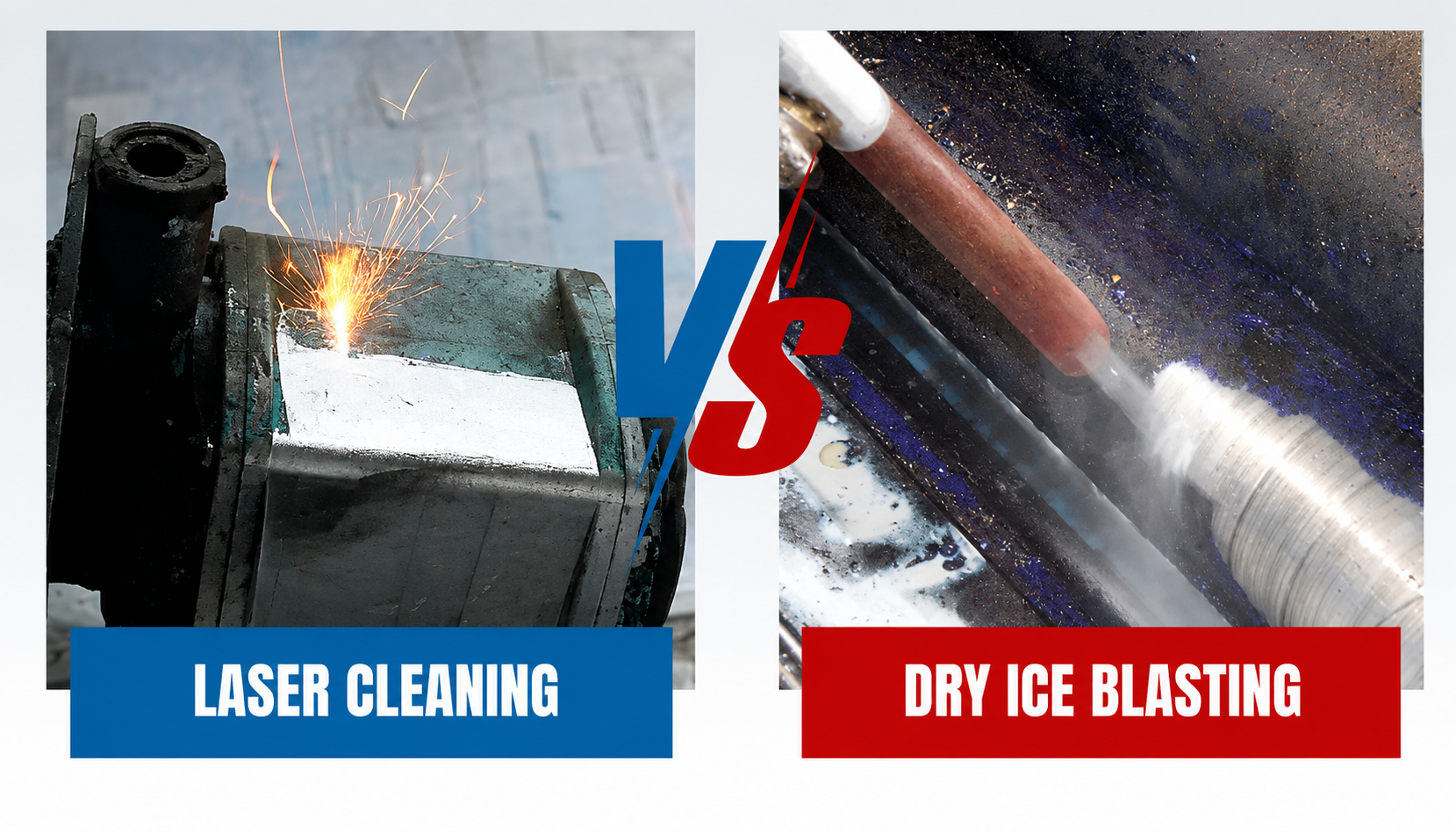
Laser cleaning and dry ice blasting are both used to remove contaminants without the heavy abrasion associated with grinding or sandblasting. But they are not interchangeable.
The simplest way to understand the difference is:
Laser cleaning is usually better for rust, oxide, paint, weld preparation, and precision metal cleaning.
Dry ice blasting is usually better for grease, adhesives, production residue, food-processing buildup, and surfaces where minimizing heat input is especially important.
Laser cleaning normally requires a higher initial investment, but it uses very few consumables. Dry ice blasting often costs less to start, but every cleaning job requires dry ice pellets and compressed air.
So the better method depends mainly on what you need to remove, what material is underneath, and how often you need to clean it.
Laser Cleaning vs. Dry Ice Blasting at a Glance
Factor | Laser Cleaning | Dry Ice Blasting |
|---|---|---|
Best at removing | Rust, oxide, paint, weld discoloration | Grease, adhesives, production residue |
Best substrates | Metals, molds, tooling, precision parts | Metals, machinery and many heat-sensitive surfaces |
Cleaning precision | Very high | Good for broad surface cleaning |
Heat input | Must be controlled | Very low |
Consumables | Minimal | Dry ice pellets + compressed air |
Initial investment | Higher | Usually lower |
Frequent daily use | More economical | Consumable costs accumulate |
Typical strength | Precision and repeatability | Flexibility and gentle cleaning |
Neither technology is universally better. They are optimized for different contamination types.
1. What Are You Trying to Remove?
This should be the first question—not machine price.
Rust, Oxide and Weld Discoloration: Laser Cleaning Wins
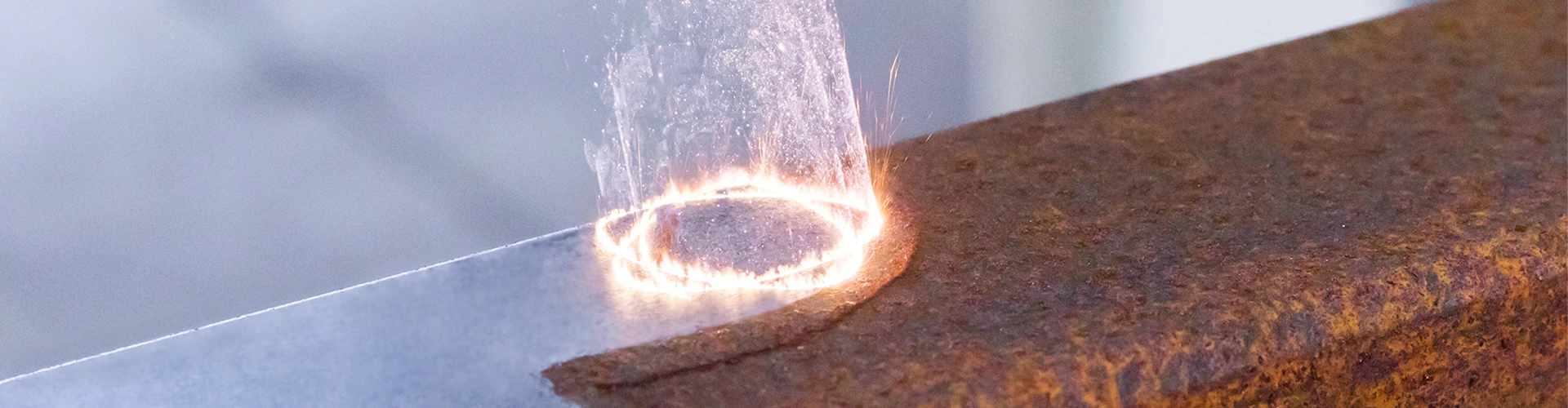
Laser cleaning is particularly effective when the unwanted layer absorbs laser energy differently from the metal underneath.
That makes rust, oxide, mill scale, heat tint, and weld discoloration natural applications for laser cleaning.
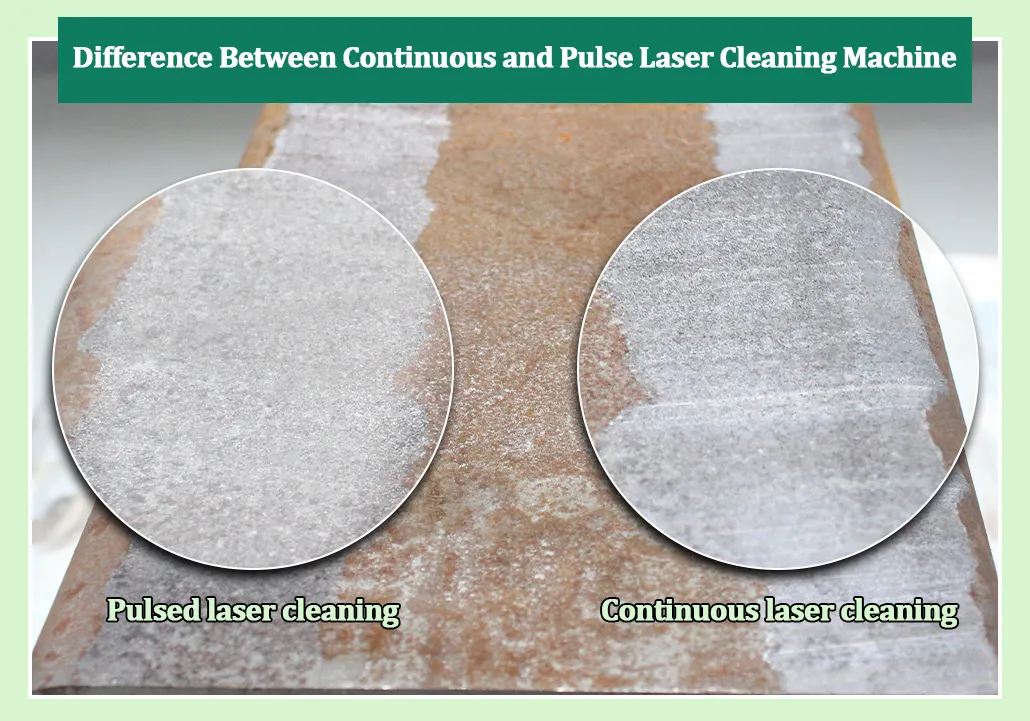
A pulsed laser cleaner can remove localized oxidation from molds, automotive parts, tools, welds, and precision components with good control.
For heavier rust and large steel structures, higher-power continuous-wave laser cleaners can provide greater removal speed.
Dry ice blasting can remove loose contamination around rusty surfaces, but strongly bonded corrosion is not its strongest application.
If rust removal is your main business, laser cleaning is usually the more appropriate technology.
Paint and Coatings: Laser Offers More Control
Both technologies can remove certain coatings, but laser cleaning gives the operator greater control over exactly where material is removed.
This is useful for selective paint stripping, weld preparation, automotive restoration, and industrial coating removal.
A pulsed laser can remove relatively thin layers while limiting the effect on the substrate. Higher-power systems can handle heavier coatings and larger areas.
Dry ice blasting can also loosen paint and coatings, particularly when the bond between the coating and substrate responds well to impact and thermal shock.
The difference is that laser cleaning is generally better when selective removal and surface precision matter, while dry ice is attractive for broader, less precision-sensitive cleaning.
Grease, Adhesives and Production Residue: Dry Ice Has the Advantage
Dry ice blasting becomes more attractive when the contamination is soft, sticky, oily, or organic rather than strongly bonded oxide.
Grease, adhesives, release agents, food residue, and production buildup can often be removed efficiently without introducing water or abrasive media.
The dry ice disappears after impact, reducing the amount of secondary blasting material that needs to be collected.
Laser cleaning can also remove oil, carbon, and certain residues from metal surfaces, but it is usually most valuable when precise surface treatment matters.
For general machinery degreasing and production residue, dry ice blasting is often the more practical choice.

2. What Material Are You Cleaning?
The substrate can change the answer completely.
Metal Surfaces
Steel, stainless steel, cast iron, molds, and many other metal components are strong applications for laser cleaning.
The process is non-contact, and properly adjusted parameters can remove contamination without grinding or mechanically wearing the surface.
This is particularly valuable for tooling, molds, precision components, and surfaces that will later be welded, coated, or bonded.
Dry ice blasting also works well on metal, especially when removing grease, adhesives, and general production contamination.
So for metals, the contaminant usually decides the winner:
Rust and oxide → laser.
Grease and residue → dry ice.
Heat-Sensitive Materials
Dry ice blasting generally has an advantage when heat input must be minimized.
Laser cleaning concentrates energy on the surface. Modern pulsed systems can control that energy precisely, but incorrect power, focus, or scanning parameters can still affect sensitive substrates.
Dry ice cleaning relies mainly on impact and rapid sublimation, which makes it useful for some plastics, composites, electrical equipment, and temperature-sensitive components.
For these materials, a sample test is essential regardless of the cleaning method.
3. Which Method Costs Less?
The cost structure is almost the opposite.
Laser cleaning machine usually requires more capital at the beginning. The machine, extraction system, safety equipment, and training create a higher startup investment.
After purchase, however, the main ongoing costs are electricity, filtration, protective optics, and routine maintenance.
Dry ice blasting normally has a lower equipment entry cost, but it requires a continuous supply of dry ice pellets and compressed air.
That means usage frequency becomes very important.
If the equipment is used only occasionally, the lower initial cost of dry ice blasting may make sense.
If cleaning becomes a daily production process, recurring dry ice purchases can accumulate quickly, while the laser continues operating primarily on electricity.
The practical rule is:
Occasional cleaning favors dry ice. Frequent repeatable cleaning makes laser increasingly attractive.
Rather than relying on a generic five-year ROI number, calculate costs using your own operating hours, local pellet price, electricity rate, labor, and cleaning volume. The original article also identifies frequency of use as a major driver of long-term cost.
4. Which Method Provides Better Surface Control?
Laser cleaning has the advantage when precision matters.
The operator can adjust laser power, pulse characteristics, scanning speed, beam width, and overlap to target a specific contamination layer.
This makes laser cleaning valuable for applications where the surface underneath must remain dimensionally accurate.
Examples include molds, tooling, weld preparation, aerospace components, precision manufacturing, and restoration of metal parts.
Dry ice blasting is less selective, but it is often more forgiving.
Instead of requiring the operator to define a narrow energy window, the process removes contamination through pellet impact and rapid sublimation.
This can be useful when broad cleaning is more important than microscopic control.
A useful way to think about it is:
Laser cleaning gives you more control. Dry ice blasting gives you a wider margin for general cleaning.
5. Which Is Better for Mold Cleaning?
This depends on what is on the mold.
For carbon deposits, oxidation, surface contamination, and applications where preserving fine texture or dimensional accuracy is important, pulsed laser cleaning is highly attractive.
It allows localized cleaning without abrasive contact and can target specific mold areas.
Dry ice blasting is excellent for removing release agents, grease, rubber residue, and general production contamination across larger mold surfaces.
Therefore:
Precision mold surface cleaning → Laser cleaning.
Routine production residue removal → Dry ice blasting.
Some factories may reasonably use both because they solve different maintenance problems.
6. Which Is Better for Heavy Industrial Equipment?
Again, the contaminant is more important than the size of the cleaning machine.
If the objective is removing rust, oxide, old paint, or preparing steel before welding and coating, high-power laser cleaning is usually the stronger option.
If the objective is removing grease, adhesives, oil, food residue, or production buildup from machinery, dry ice blasting can be more convenient.
This distinction is especially important for buyers comparing the two technologies for factory maintenance.
A laser cleaner is not simply a more expensive dry ice machine.
They are designed to solve different surface problems.
7. What About Large-Area Cleaning?
Large surface area does not automatically favor one technology.
High-power laser cleaning systems can process large steel structures, machinery, tanks, and industrial components, particularly when rust and coatings are the main contaminants.
Dry ice blasting can cover complex machinery quickly when contamination is relatively loose or organic.
The important comparison is not advertised square meters per hour.
It is:
How long does the complete job take to reach the required surface condition?
That includes setup, cleaning, secondary cleanup, consumables, and any post-treatment required.
8. Safety and Environmental Differences
Both methods reduce some of the secondary waste associated with traditional abrasive blasting, but neither is risk-free.
Laser cleaning removes material by ablation, which can create fumes and fine particles. Effective extraction and filtration are especially important when cleaning painted, coated, or contaminated metals.
Laser systems also require appropriate laser safety controls and operator training.
Dry ice blasting does not leave blasting media behind because the CO₂ pellets sublimate into gas.
However, CO₂ can accumulate in enclosed spaces and displace oxygen, so adequate ventilation remains essential.
The removed contamination itself also remains waste regardless of which cleaning method is used.
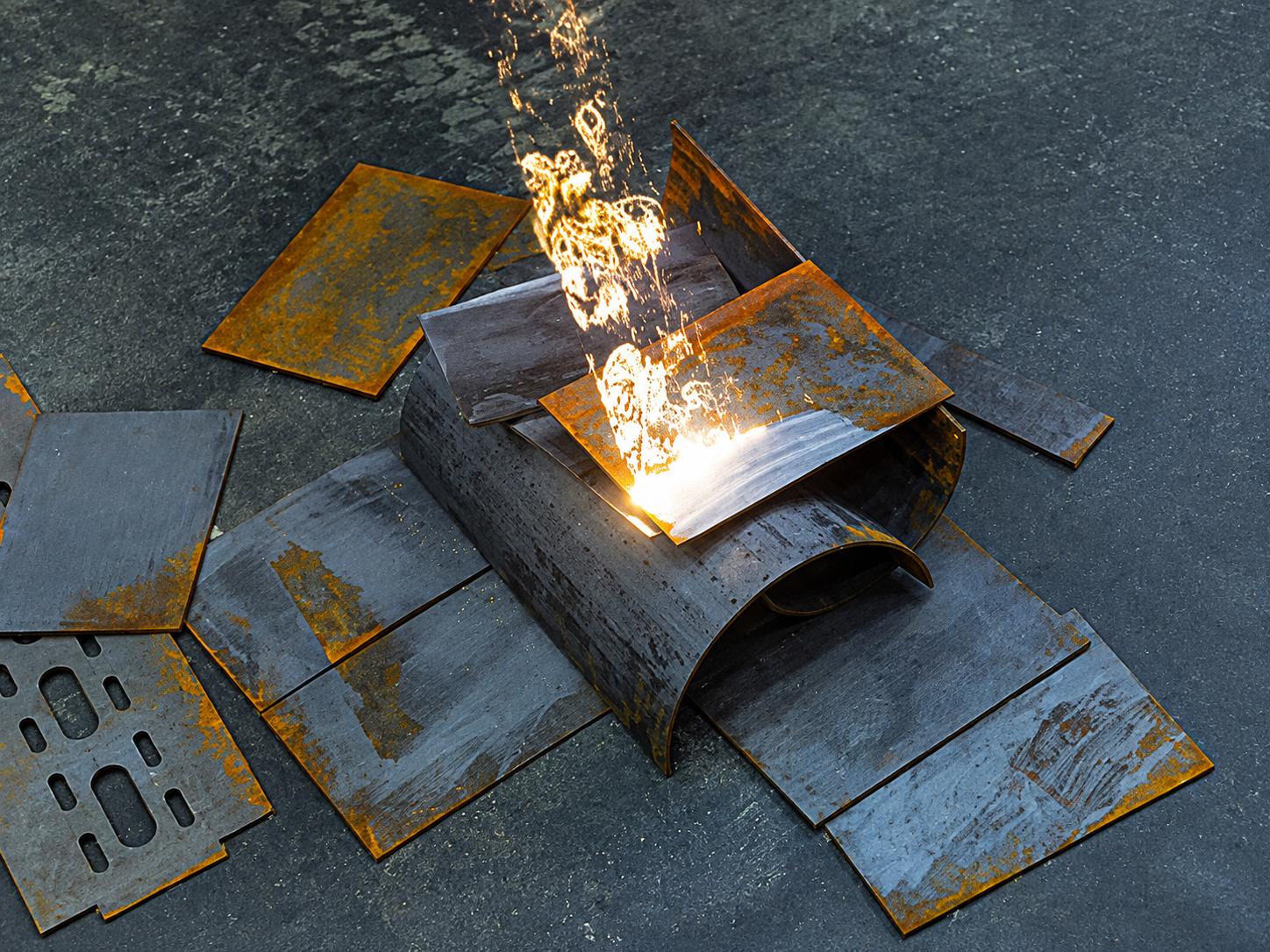
Laser Cleaning vs. Dry Ice Blasting: Which Should You Choose?
The decision becomes much simpler when you start with your primary contamination.
Choose laser cleaner when most of your work involves rust, oxide, paint, weld preparation, metal restoration, molds, or precision surfaces.
It becomes particularly attractive when the same cleaning process is performed repeatedly and consumable costs need to remain low.
Choose dry ice blasting when most of your work involves grease, adhesives, production residue, food-processing buildup, or thermally sensitive surfaces.
It can also make sense when cleaning is occasional and you prefer a lower initial equipment investment.
For factories with very mixed cleaning requirements, the two technologies can complement each other rather than compete directly.
Conclusion
Laser cleaning and dry ice blasting are both effective industrial cleaning methods, but they are best at different jobs.
For rust, oxide, paint, weld preparation, and precision metal surfaces, laser cleaning is generally the better choice.
For grease, adhesives, production residue, and heat-sensitive cleaning, dry ice blasting is often more practical.
Laser cleaning requires a higher initial investment but offers precise control and very low consumable requirements.
Dry ice blasting is easier to enter at a lower equipment cost but requires a continuous supply of dry ice and compressed air.
So instead of asking:
“Which technology is better?”
Ask:
“What contamination do I remove most often, and what surface must remain underneath?”
That answer usually determines the right cleaning method.
Considering whether laser cleaning fits your application?
Send LaserCleanerPro photos or samples of the parts you need to clean, together with the material, contamination type, cleaning area, and expected workload. The engineering team can arrange an application test and recommend a suitable pulsed or continuous laser cleaning configuration before you invest.