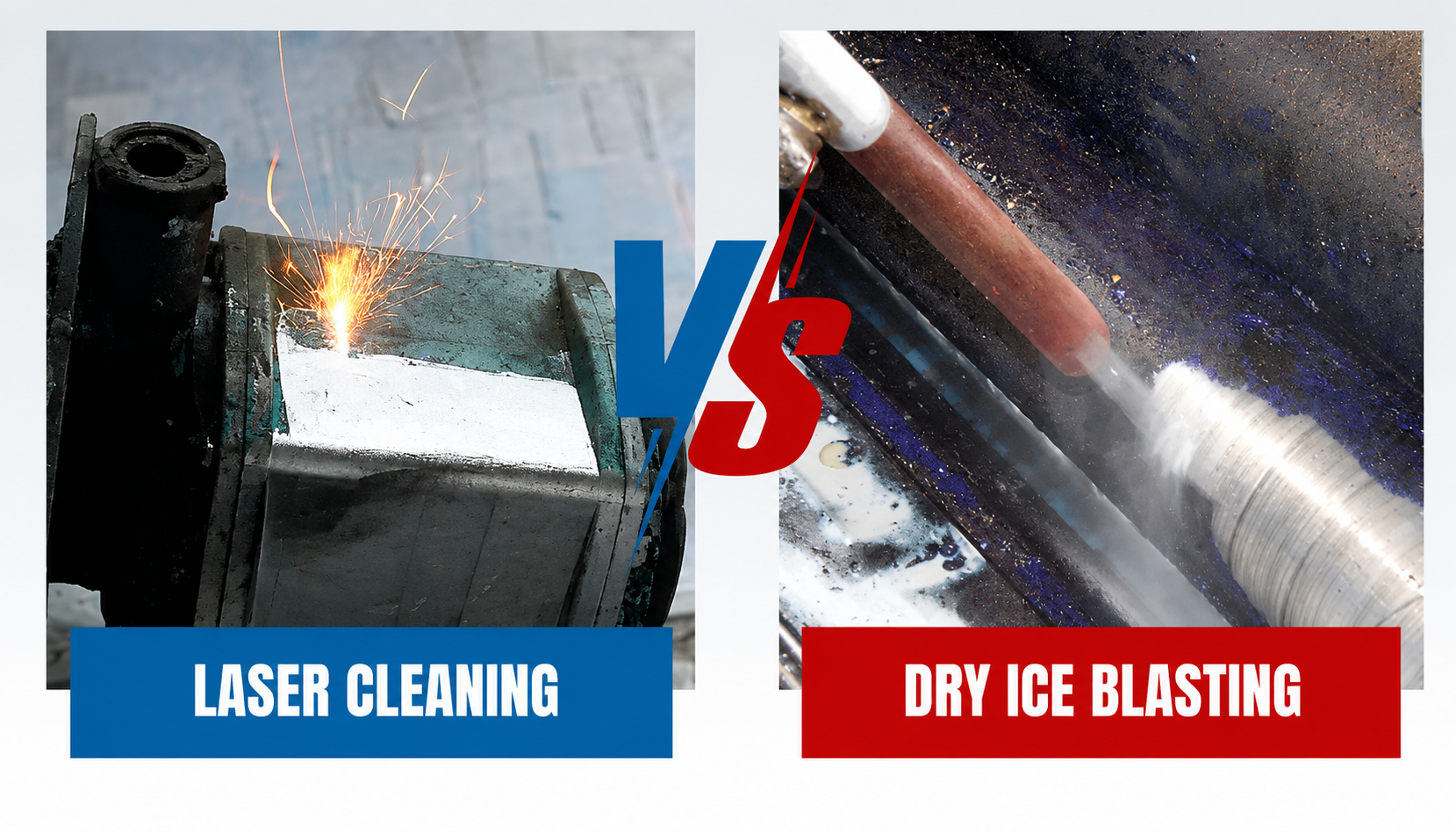
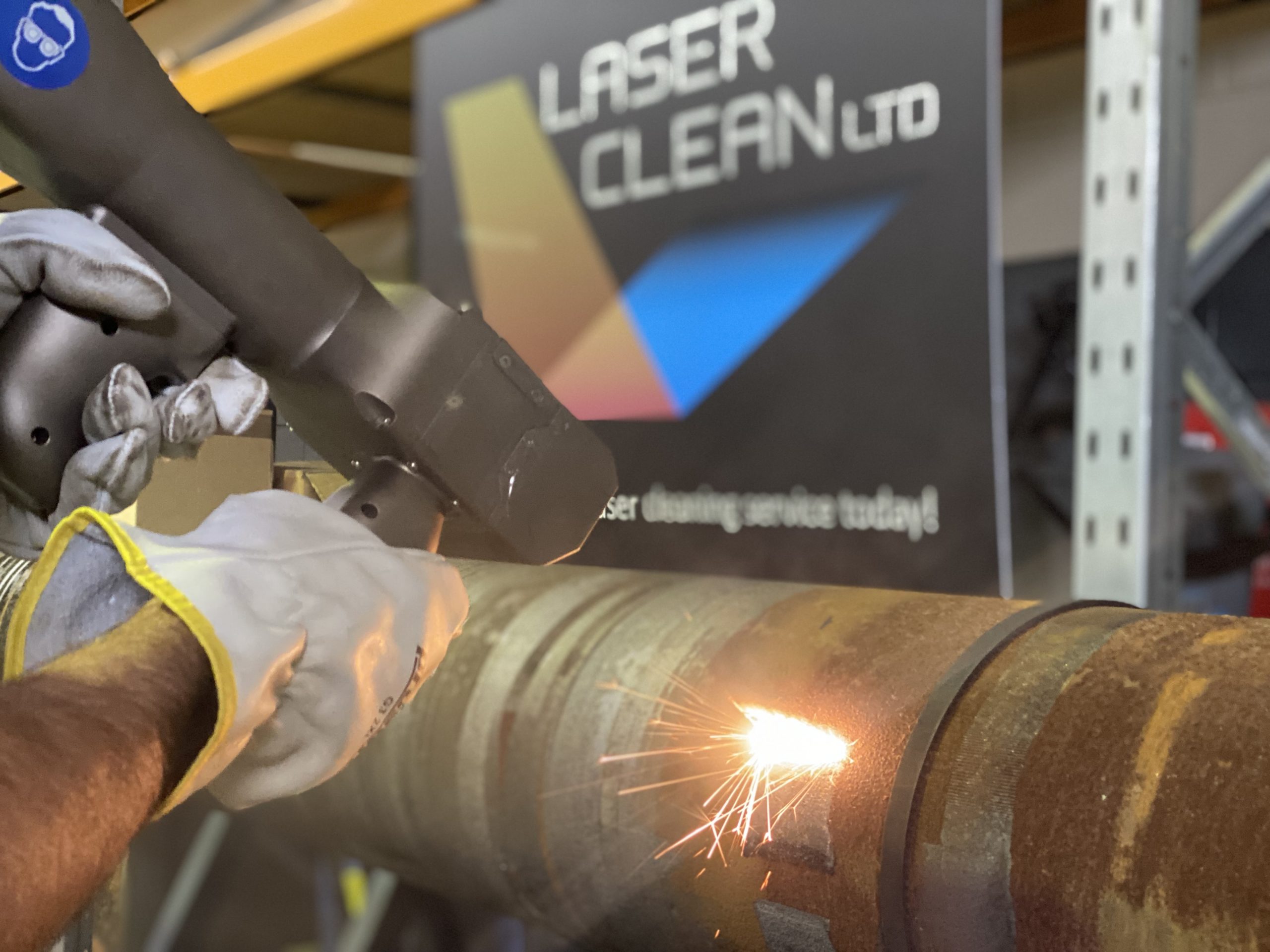
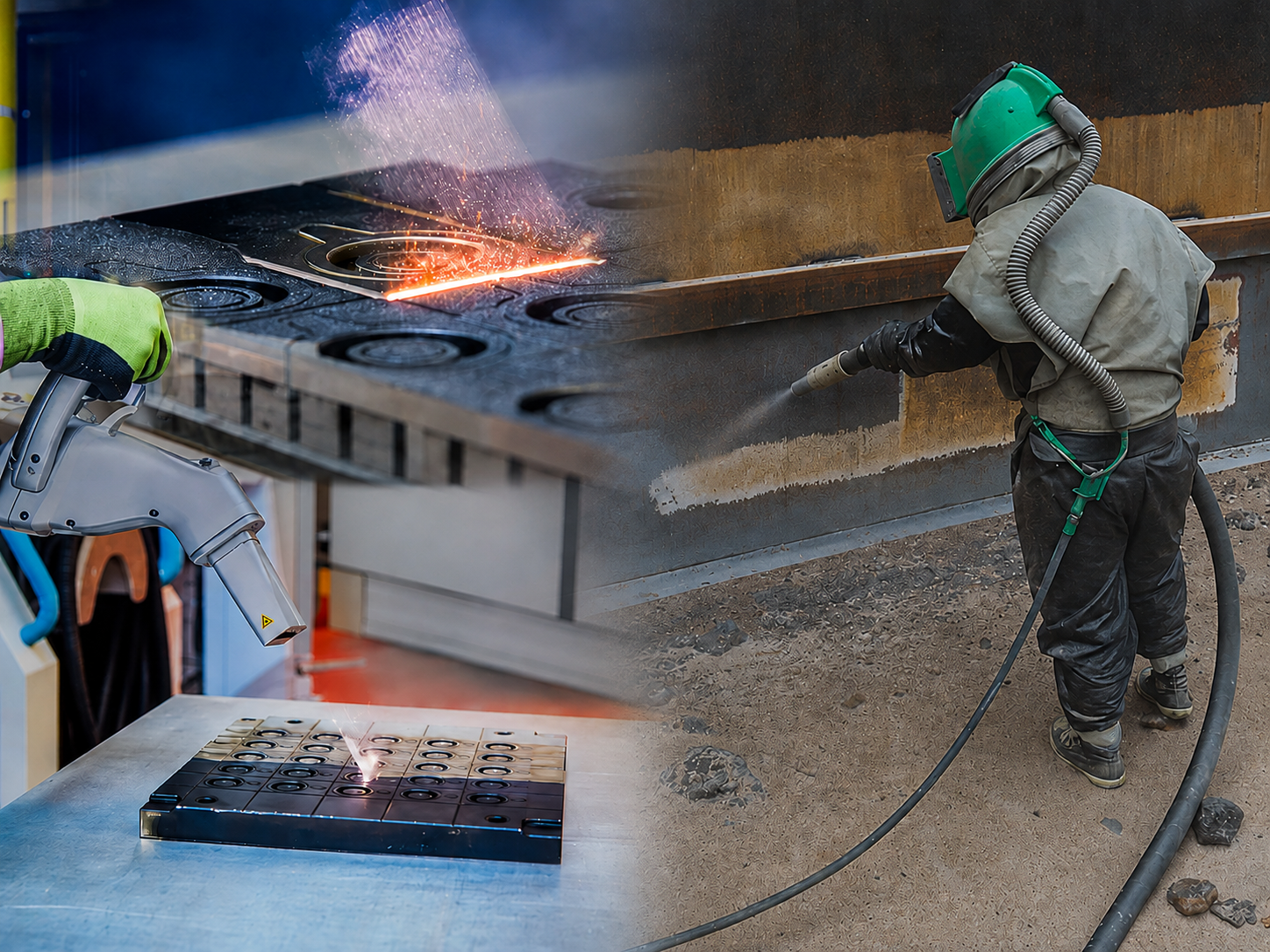
Laser cleaning and sandblasting can both remove rust, paint, oxide and other surface contamination from metal, but they solve different problems.
The simplest answer is:
Choose laser cleaning when you need precision, lower surface disturbance, less cleanup or selective removal.
Choose sandblasting when you need to remove heavy rust or thick coatings from large, durable surfaces quickly—or when the next coating requires an abrasive surface profile.
Neither method is automatically better.
For buyers comparing a laser cleaning machine, the right choice depends mainly on five things:
Rust or coating thickness.
Surface area.
How sensitive the base material is.
What surface condition you need afterward.
How much cleanup and consumable handling you are willing to accept.
Here is the practical comparison:
Factor | Laser Cleaning | Sandblasting |
|---|---|---|
Light rust / oxide | Excellent | Effective |
Heavy rust on large steel | Possible, but power and throughput matter | Major strength |
Paint removal | Strong for selective and controlled stripping | Strong for broad stripping |
Thin / precision parts | Strong advantage with suitable parameters | Higher risk of unwanted surface change |
Large structures | Higher-power system required | Often more productive |
Surface roughening | Limited / controllable | Major advantage |
Media consumables | No continuous abrasive media | Requires abrasive media |
Cleanup | Usually lower | Media and dust cleanup required |
Selective cleaning | Excellent | Limited |
Initial equipment cost | Usually higher | Usually lower |
Best fit | Precision, selective, clean workflow | Large-area aggressive preparation |
1. Which Is Better for Rust and Paint Removal?
The answer changes depending on what you are trying to remove.
Light and Moderate Rust
For light surface rust, oxidation and localized corrosion, laser cleaning is often the more controlled option.
A laser cleaner for rust removal can target the corrosion without firing abrasive particles across the entire surface.
This is especially useful for:
Machined components.
Molds.
Automotive parts.
Weld areas.
Thin metal.
Edges and detailed features.
Parts where dimensions or existing surface condition matter.
Sandblasting can also remove light rust very effectively, but it changes the surface mechanically at the same time.
That may be useful—or undesirable.
If the goal is simply:
“Remove the rust while disturbing the underlying surface as little as practical,”
laser cleaning usually deserves the first test.
Heavy Rust and Thick Scale
This is where sandblasting remains very competitive.
On:
Structural steel.
Storage tanks.
Ship components.
Bridges.
Large frames.
Heavy fabrication.
thick rust and scale may cover hundreds of square meters.
Sandblasting can attack a broad area aggressively and simultaneously create the surface profile required for many coating systems.
The original draft correctly identifies this as one of sandblasting's strongest use cases: heavy steel structures, thick scale and applications where abrasive profiling is part of the required finish.
Laser cleaning can also handle heavier rust, especially with higher-power systems, but you should compare actual throughput before assuming it will replace blasting economically.
For heavy industrial rust removal, the right question is:
How many square meters per hour can each process achieve on my actual corrosion level?
—not simply which technology is newer.
Paint and Coating Removal
Paint removal is more application-dependent.
A laser can be very attractive when you need:
Selective paint stripping.
Removal around weld zones.
Cleaning only a defined area.
Protection of adjacent surfaces.
Less media contamination.
Localized automotive restoration.
Precision coating removal before bonding or welding.
A laser paint removal machine can remove selected coating areas without blasting the entire component.
Sandblasting is often more practical when the job is:
A large painted steel structure.
A tank.
A heavy frame.
A large panel where the complete coating must be removed.
A surface that needs both stripping and roughening before repainting.
So for paint:
Selective / precision stripping → laser has an advantage.
Large-area aggressive stripping + surface profiling → sandblasting often has an advantage.
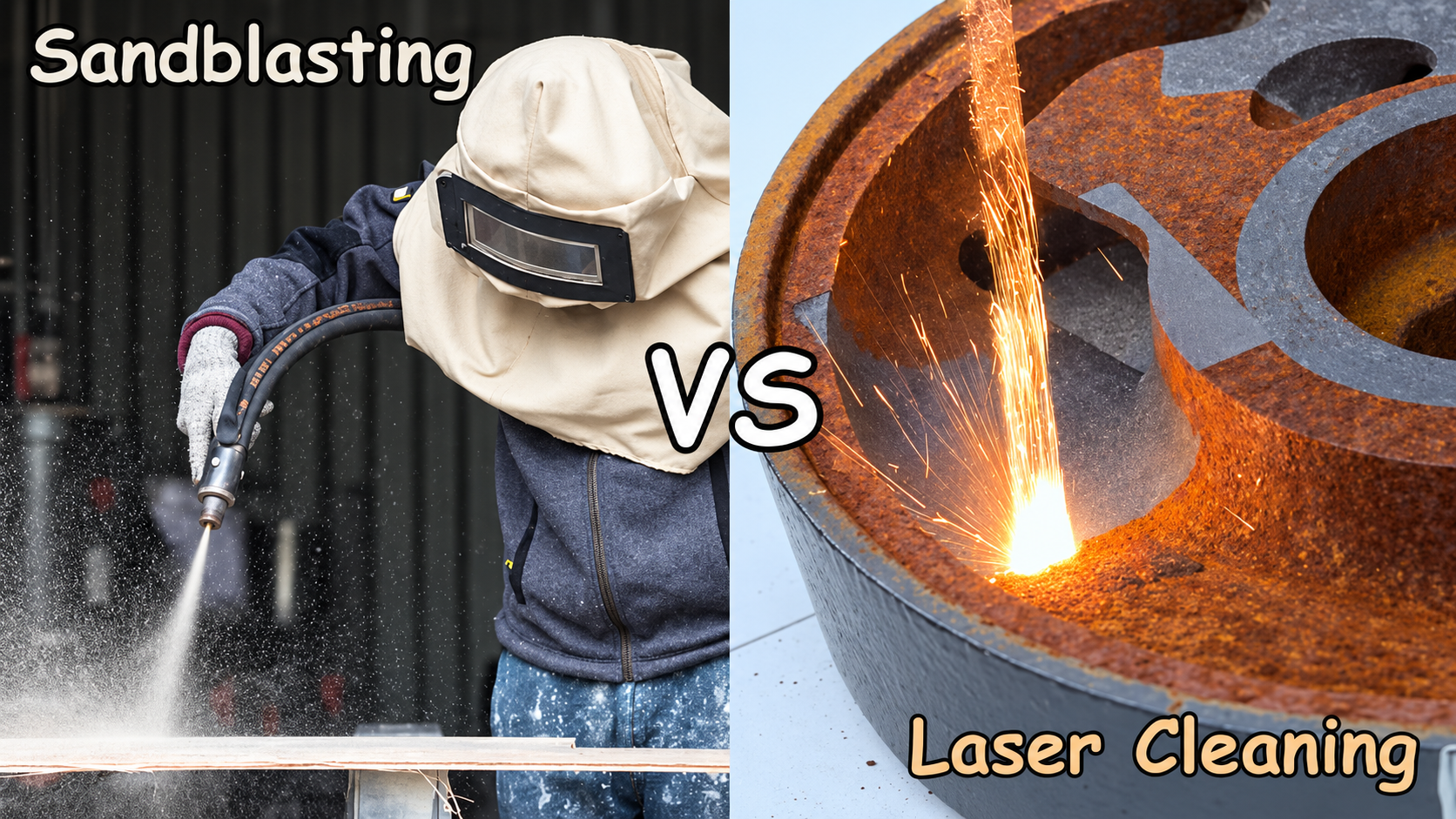
2. When Is Laser Cleaning the Better Choice?
Laser cleaning becomes more valuable when surface control matters more than maximum raw removal speed.
Thin or Precision Metal Parts
Abrasive particles physically impact the surface.
That impact can intentionally roughen the metal, which is useful for coating preparation, but it can also alter edges, fine details or the original surface finish.
A properly selected pulsed laser cleaner gives the operator much greater control over where energy is applied.
That is why pulsed cleaning is frequently considered for:
Precision components.
Tools and molds.
Thin sheet metal.
Machined surfaces.
Automotive panels.
Localized weld preparation.
The original draft makes this distinction clearly by separating thin and precision parts from heavy structural steel applications.
The important caveat is:
Laser cleaning is not automatically harmless.
Wrong parameters, excessive dwell time or inappropriate CW power can still change or heat a surface.
The advantage is greater process control—not immunity from process damage.
Selective Cleaning
This is one of laser cleaning's clearest advantages.
Imagine you only need to clean:
A 30 mm weld path.
One bonding area.
One rusty flange.
A small region around a repair.
A mold cavity.
With sandblasting, containment and masking may become a significant part of the job.
With a laser, the beam can be directed specifically at the target area.
For factories, that can make industrial laser cleaning particularly useful before:
Welding.
Bonding.
Coating.
Inspection.
Assembly.
Lower Media and Cleanup Requirements
Laser cleaning does not require a continuous supply of blasting abrasive.
That means you avoid much of the workflow associated with:
Media storage.
Media recovery.
Spent abrasive.
Large volumes of blast dust.
Cleanup of abrasive particles around the work area.
That does not mean laser cleaning produces no contamination.
Rust, paint and coating material still have to go somewhere, and appropriate fume or particle extraction may be required.
But the cleanup structure is very different.
The original article correctly identifies waste and cleanup as an important distinction between the two processes.
Indoor and Localized Work
Laser cleaning can also become attractive where blasting media would be difficult to contain.
For example:
Production equipment that cannot easily be moved.
Indoor maintenance.
Localized cleaning near other machinery.
Repair work.
Small parts.
Controlled production lines.
A portable laser cleaner may allow the process to move to the part rather than requiring the part to enter a blasting room.
Again, extraction and laser safety still matter—but you are solving a different containment problem.

3. When Is Sandblasting the Better Choice?
Laser cleaning should not be positioned as a universal replacement for sandblasting.
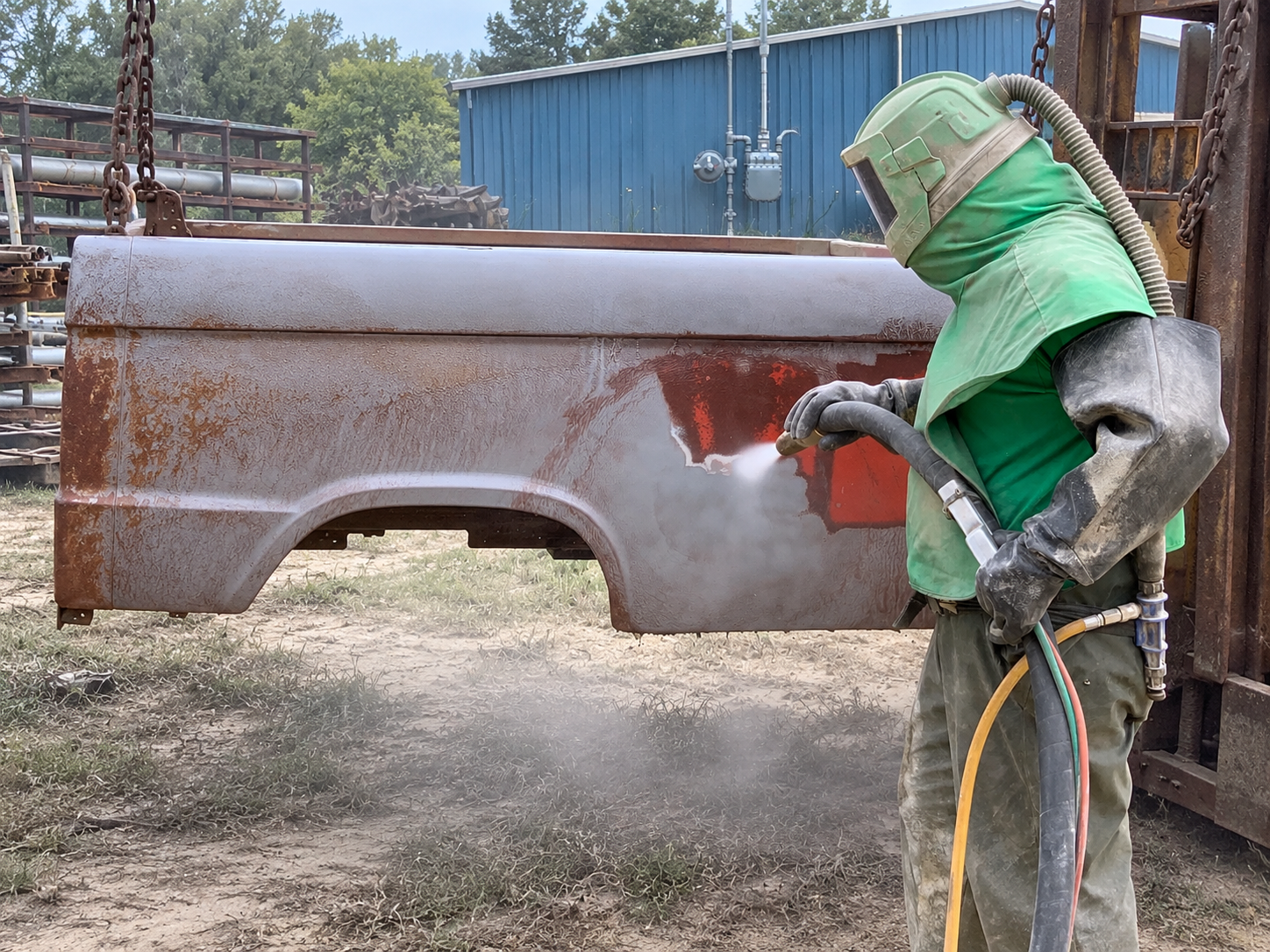
There are jobs where blasting remains the more practical process.
Large Areas of Heavy Rust
If the application is hundreds of square meters of heavily rusted structural steel, raw area throughput becomes extremely important.
A blast system can cover a wide area quickly.
The equipment can also be relatively simple compared with a high-power laser system capable of comparable industrial production.
This is why structural steel, shipbuilding and large fabrication remain strong sandblasting applications.
The original article similarly identifies bulk steel preparation as a case where blasting's high production throughput still matters.
When You Need an Anchor Profile
This point is especially important.
Removing contamination and preparing a surface for coating are not always the same thing.
Some coating systems need a specific rough surface profile for adhesion.
Sandblasting does two jobs at once:
Removes rust / coating
and
Creates an abrasive profile
Laser cleaning can remove contamination while preserving more of the existing surface condition, but that may not produce the profile required by the next coating system.
So if your specification says:
“Clean to this standard and produce this anchor profile,”
the required surface specification should drive the process choice.
Do not choose laser simply because it generates less waste.
Very Thick Coatings
For a thick multilayer coating across a large steel structure, removing the material layer by layer with a laser may take longer than mechanically blasting it away.
Laser may still make sense for selective areas.
But for full-surface stripping, sandblasting can remain more economical.
Low Initial Budget
Sandblasting equipment generally has a lower entry cost.
That matters for small businesses with enough outdoor space or an existing blast room and where:
Media cost is manageable.
Waste handling is already established.
The work is large and robust.
Surface profiling is desirable.
In that environment, replacing the blast system with a laser simply because laser cleaning has lower media consumption may not make financial sense.
4. Which One Costs Less—and How Should You Choose?
This is where many comparisons become misleading.
Sandblasting normally has a lower initial equipment cost.
Laser cleaning usually requires a higher capital investment.
But operating cost works differently.
Sandblasting Costs
A blasting process may include:
Abrasive media.
Compressed air.
Nozzles and hoses.
PPE.
Containment.
Media recovery.
Cleanup.
Waste disposal.
Labor.
The more frequently you blast, the more those recurring costs matter.
Laser Cleaning Costs
A laser cleaning machine has higher upfront equipment cost, but routine operating costs are generally concentrated around:
Electricity.
Protective optics.
Fume filters.
Cooling maintenance.
Labor.
Periodic machine maintenance.
There is no continuous abrasive-media feed.
That means the right cost comparison is not:
Laser machine price vs blast machine price.
It is:
Total cost per completed job.
Use Cost per Job Instead of Purchase Price
For each process, calculate:
Cost per Job = Labor + Consumables + Energy + Cleanup + Waste + Equipment Cost Allocation
Then include the time required.
A blasting process that looks inexpensive per hour can become more costly if the shop spends substantial additional time on:
Masking.
Media setup.
Cleaning.
Waste removal.
Rework.
Likewise, a laser system can look inexpensive to operate but still be a poor investment if the machine sits idle most of the month.
A Better Buying Decision Matrix
Your Application | Better Starting Point |
|---|---|
Light rust on precision parts | Laser cleaning |
Mold cleaning | Laser cleaning |
Weld preparation | Laser cleaning |
Selective paint removal | Laser cleaning |
Thin automotive panels | Pulsed laser cleaning |
Indoor localized maintenance | Laser cleaning |
Heavy structural rust | Compare high-power laser vs blasting |
Large steel surfaces | Often sandblasting |
Thick multilayer coating | Often sandblasting |
Surface needs strong anchor profile | Sandblasting |
Historic / sensitive surface | Test laser first |
Maximum raw area throughput | Often sandblasting |
Test Your Actual Part Before Buying
If you are considering an industrial laser cleaner, do not base the decision on one showroom demo.
Send the supplier:
Your actual metal.
Real rust.
Actual paint.
Your coating thickness if known.
Your required final surface.
Ask them to record:
Power.
Cleaning width.
Number of passes.
Total cleaning time.
Final surface condition.
Then compare that with the blasting process you currently use.
The original article reaches essentially the same conclusion: actual material, surface condition, square footage and production requirement should determine the choice rather than relying on generic process claims.
Conclusion
Laser cleaning vs sandblasting—which is better?
For precision rust removal, selective paint stripping, thin parts, molds, weld zones and applications where reducing abrasive media and cleanup matters, laser cleaning usually has the stronger advantage.
For large steel structures, very heavy rust, thick coatings and jobs that require an aggressive surface profile, sandblasting can still be faster and more economical.
The key difference is:
Laser cleaning prioritizes control.
Sandblasting prioritizes aggressive surface removal and profiling.
Neither method wins every application.
If your goal is simply:
“Remove this contamination while preserving as much of the existing surface as practical,”
start by testing laser cleaning.
If your goal is:
“Strip hundreds of square meters quickly and leave a rough surface ready for coating,”
sandblasting may still be the better process.
Before buying a laser cleaner for metal, send LaserCleanerPro photos or samples of your rust, paint or oxide layer, along with the material, cleaning area and required surface condition.
A real sample test will tell you far more than a generic “laser vs sandblasting” comparison—and it lets you compare cleaning quality, processing time and actual cost before committing to the equipment.