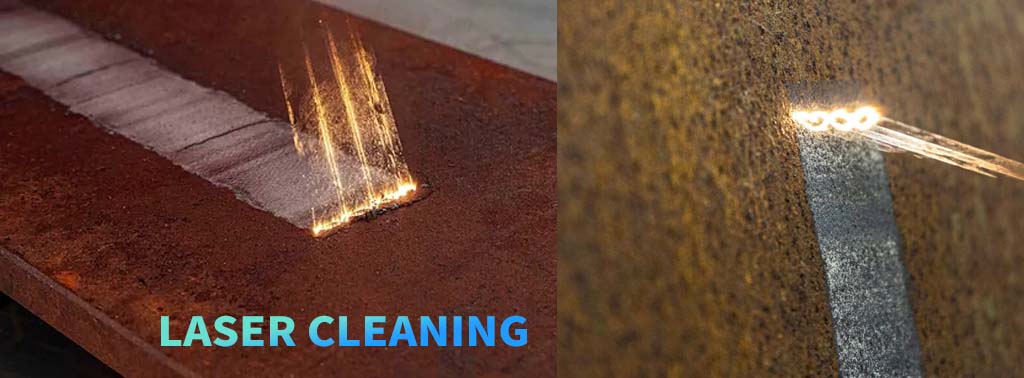
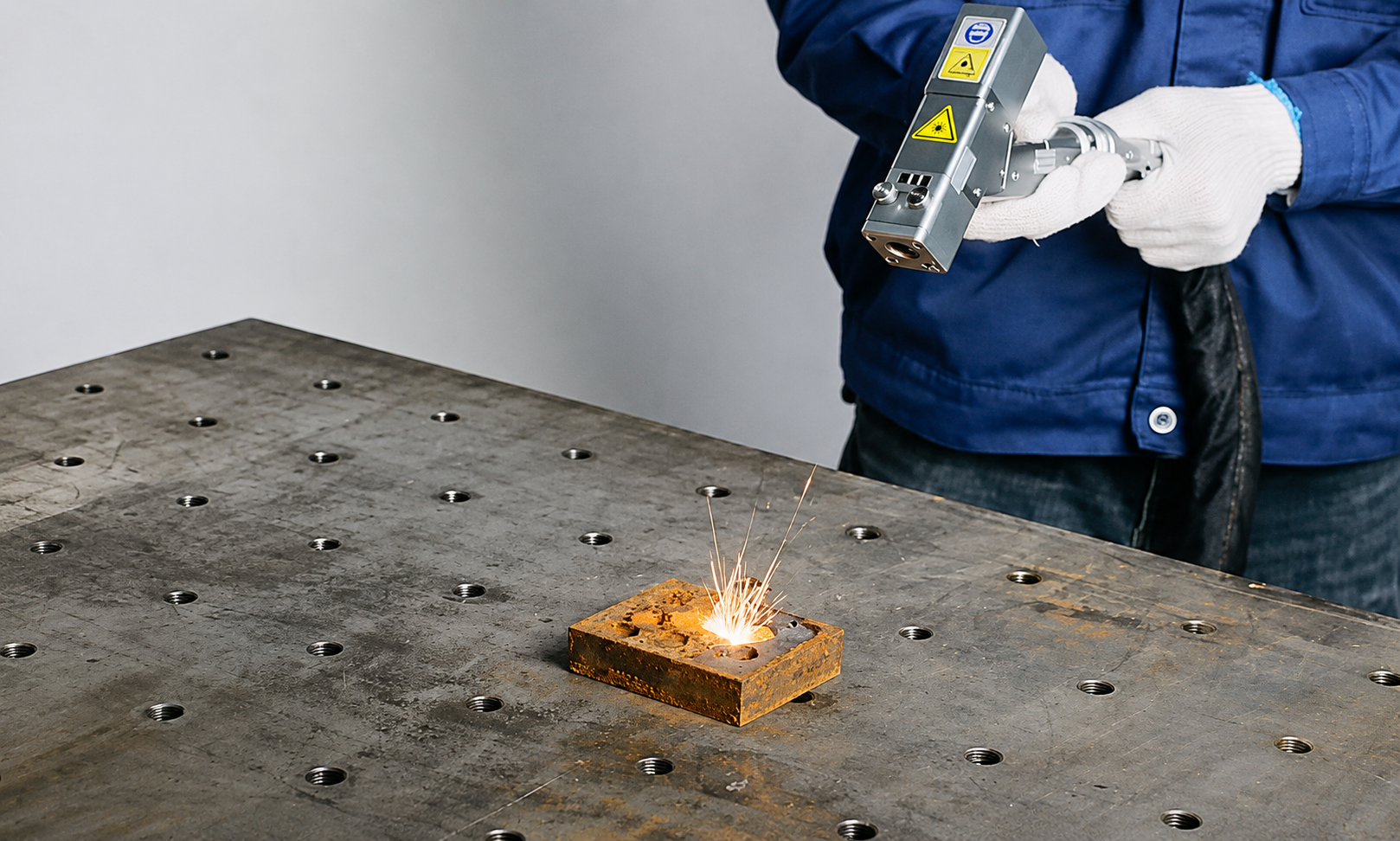
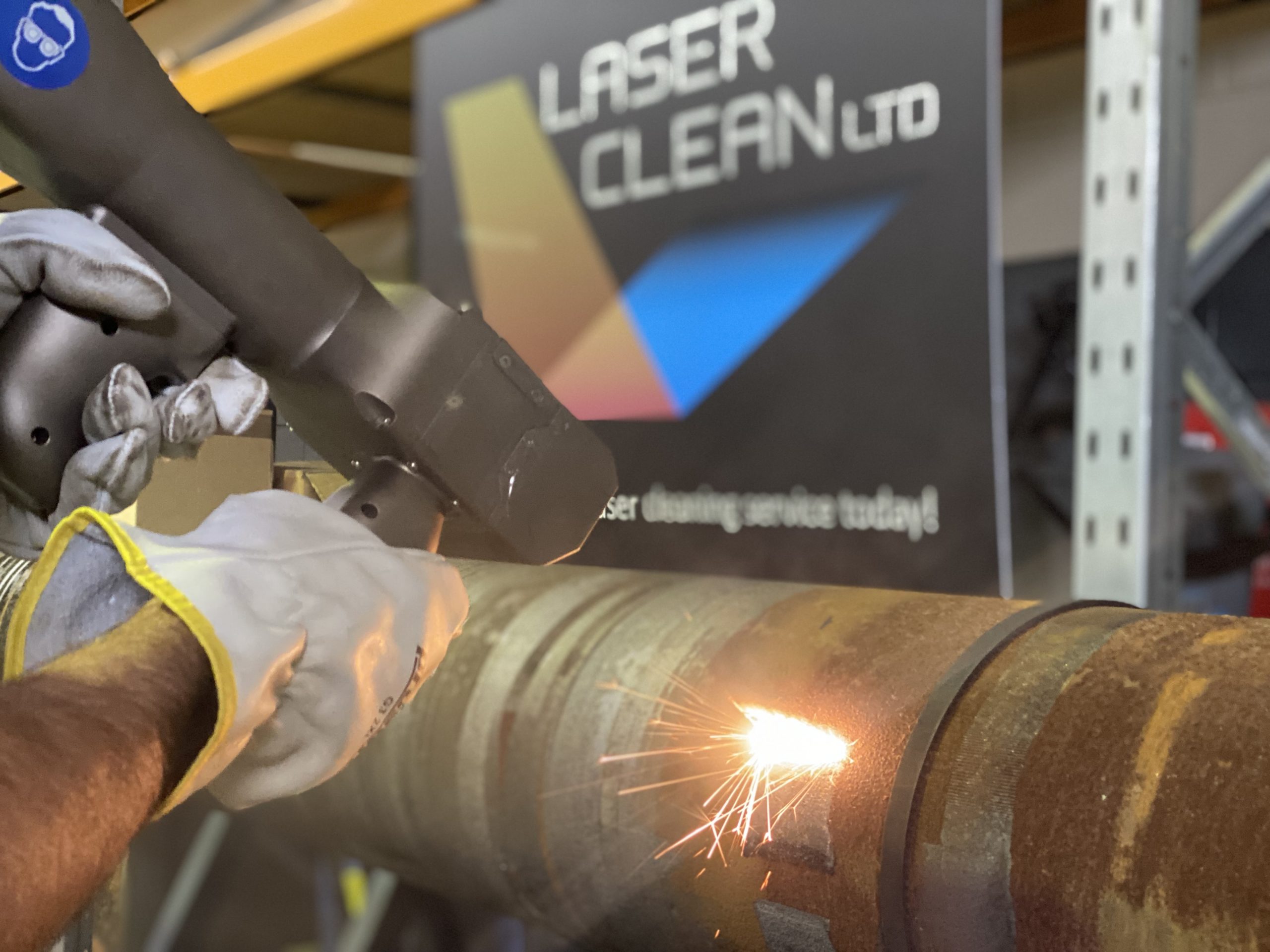
Air-cooled and water-cooled laser cleaning machines can both remove rust, paint, oxide and coatings effectively.
The better choice depends on laser type, power, working time, portability and thermal load—not simply on which cooling system sounds more industrial.
In general:
Choose air cooling when portability, compact size and simple maintenance are priorities.
Choose water cooling when sustained high output, long production runs and heavy industrial cleaning are the priority.
But there is no universal rule such as:
“Below 300W = air cooled, above 300W = water cooled.”
Current laser-cleaner configurations show why. Some manufacturers offer 300W and 500W pulsed systems with air cooling, while others use water cooling at the same power levels. Some 1500W CW systems are also available in either air- or water-cooled configurations.
For a buyer comparing a laser cleaning machine, the more useful question is:
“Does this cooling system match how I will actually use the machine?”
Factor | Air-Cooled | Water-Cooled |
|---|---|---|
Portability | Usually better | Usually lower |
Machine size | More compact | Often larger |
Setup | Simpler | More components |
Cooling maintenance | Lower | Higher |
Coolant required | No | Yes |
Long continuous operation | Depends on machine design | Strong advantage |
High thermal load | More limited | Better suited |
Mobile cleaning | Strong advantage | Less convenient |
Industrial production | Possible on suitable models | Common choice |
Automatically better? | No | No |
1. What Is the Difference Between Air and Water Cooling?
The cooling system does not remove the rust.
Its job is to remove heat generated inside the laser source, electronics and related components so the machine can operate within its designed temperature range.
How Air Cooling Works
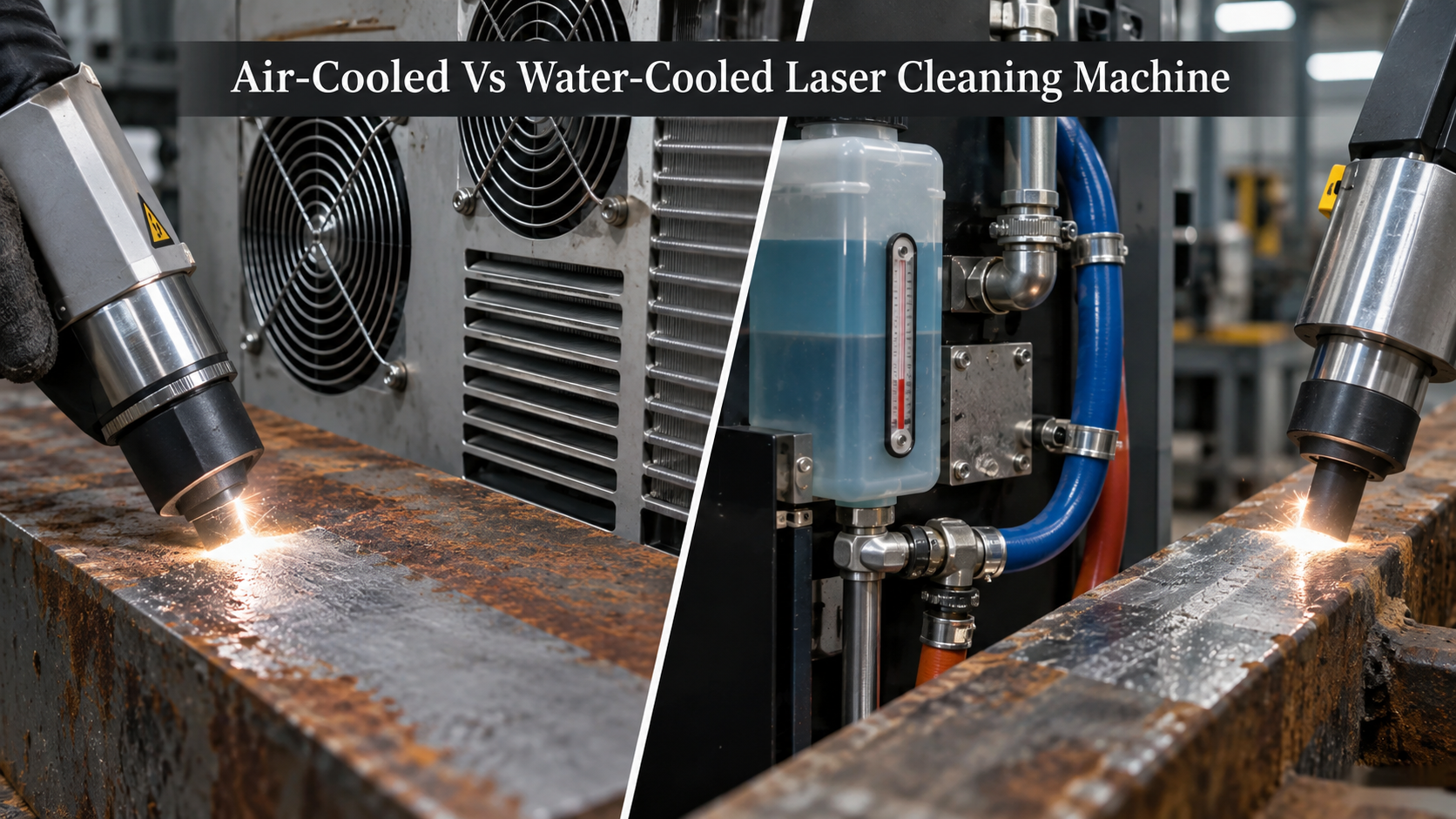
An air-cooled laser cleaner usually relies on fans, heat sinks and internal airflow.
The biggest advantages are simplicity and portability.
There is no cooling-water circuit, external chiller or coolant tank to manage.
That usually means:
Smaller machine size
Lower total weight
Easier transport
Fewer cooling components
No coolant replacement
Lower cooling-system maintenance
This is why air cooling is particularly attractive for a portable laser cleaner used for field work, automotive restoration, mold cleaning or other jobs where the equipment moves frequently.
Current commercial systems show that air cooling is not limited to very low power. For example, some current pulsed platforms offer air-cooled configurations through 300W or 500W.
How Water Cooling Works
A water-cooled machine circulates coolant through a closed system and removes heat through a chiller or heat exchanger.
This architecture can provide greater heat-removal capacity during sustained operation.
That becomes useful when:
The laser source generates more waste heat
Average power is high
Cleaning continues for long periods
Production downtime is expensive
Ambient conditions are demanding
LaserCleanerPro's current high-power CW systems use water cooling specifically to maintain stable output during long industrial cleaning runs.
The tradeoff is additional hardware.
A water-cooled system may include:
Chiller
Coolant reservoir
Pump
Hoses
Filters
Temperature monitoring
These components increase size and maintenance requirements.
Does Water Cooling Clean Better?
Not automatically.
Cooling type does not directly determine:
Rust-removal quality
Paint-removal quality
Surface damage
Pulse control
Cleaning width
Cleaning speed
Those depend on the complete laser system.
A well-designed air-cooled pulsed laser cleaner can be the better tool for precision oxide removal, while a high-power water-cooled CW system can be much better for large-area heavy rust.
The cooling system supports the laser's workload.
It does not define cleaning quality by itself.
2. When Should You Choose an Air-Cooled Laser Cleaner?
Air cooling makes the strongest case when mobility and simplicity matter more than maximum continuous output.
Mobile and On-Site Cleaning
If the machine regularly travels between customer locations, every kilogram and component matters.
Typical applications include:
Automotive restoration
Mobile rust removal
Mold maintenance
Equipment repair
Localized coating removal
Field maintenance
An air-cooled machine avoids transporting a separate water-cooling system and reduces the number of components that need to be secured inside a van or moved around a job site.
For that reason, air cooling is often attractive for a laser cleaner for metal used by a mobile service business.
Precision Pulsed Cleaning
Many pulsed laser-cleaning applications do not require the same continuous thermal load as large-area CW cleaning.
Typical jobs include:
Oxide removal
Light rust
Weld cleaning
Mold cleaning
Paint removal on smaller areas
Precision parts
Heat-sensitive surfaces
LaserCleanerPro currently positions its pulsed range from 100–500W around precision, oxide, paint and mold cleaning, while its high-power CW systems are aimed at heavy rust and large-area throughput.
That application difference often aligns naturally with cooling requirements.
Small Workshops
A small repair or fabrication shop may care more about:
Floor space
Installation simplicity
Easy movement
Low maintenance
Standard electrical access
than maximum continuous cleaning time.
In that environment, air cooling can make ownership easier.
When Air Cooling Is Not Enough
The key warning sign is not simply wattage.
It is thermal demand over time.
Ask whether your jobs involve:
Long uninterrupted cleaning sessions
Large steel surfaces
Heavy rust
Thick coatings
High production utilization
Several shifts per day
If the machine is regularly operating near its thermal limit, the advantages of a compact air-cooled design begin to matter less.
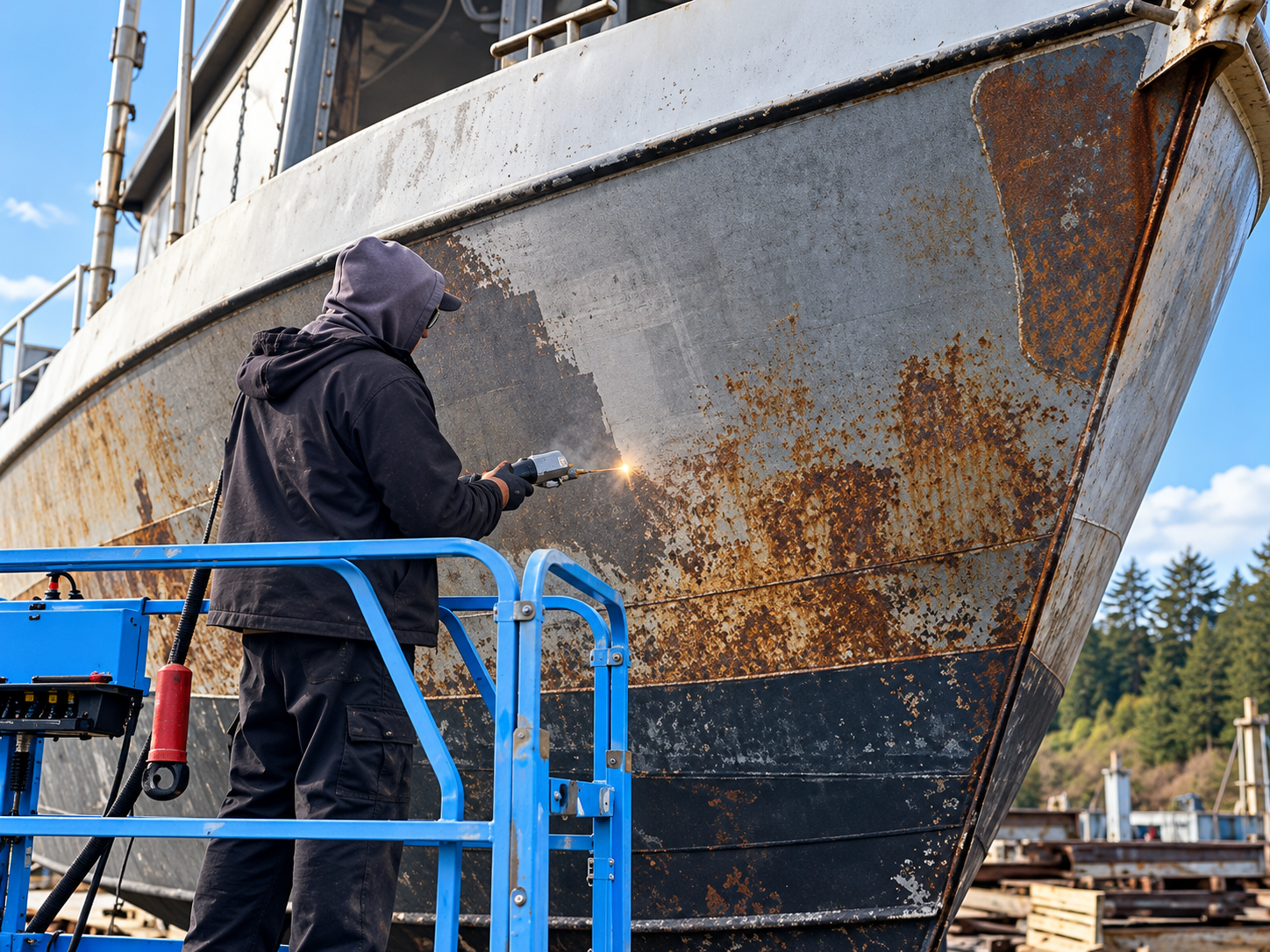
3. When Should You Choose a Water-Cooled Laser Cleaner?
Water cooling becomes more attractive when cleaning throughput and sustained operation matter more than portability.
Heavy Rust and Large Steel Surfaces
High-power CW laser cleaners are commonly used for:
Structural steel
Shipyards
Tanks
Large machinery
Heavy rust
Mill scale
Thick coatings
These applications involve a very different workload from cleaning one mold or automotive component.
LaserCleanerPro's LCW1500–3000W range is specifically water-cooled and positioned for high-throughput heavy rust removal, while its high-power product page describes water cooling as a way to hold output during long runs.
For this kind of industrial laser cleaner, portability is usually a secondary concern.
Long Production Shifts
If a machine operates repeatedly through a full production shift, thermal stability becomes more important.
Examples include:
Manufacturing lines
Industrial maintenance
Batch cleaning
Shipyard work
Large fabrication plants
Automated cleaning cells
Water cooling provides more capacity to remove accumulated heat.
That does not mean every water-cooled system can automatically operate 24/7.
The actual continuous-duty capability still needs to be confirmed from the specific machine manufacturer.
The original draft used hard rules such as “8-hour shift = water cooled” and “300W+ = mandatory water cooling.”
The direction is useful, but the cutoff is too rigid.
A better rule is:
The longer and harder the machine runs, the stronger the case for water cooling.
High Ambient Temperatures
Air cooling ultimately transfers machine heat into the surrounding air.
If the workshop is already very hot, the temperature difference available for air cooling becomes smaller.
That can make thermal management more challenging.
Water cooling can provide more controlled heat removal, especially in production environments.
But check the actual machine's permitted working-temperature range rather than assuming every water-cooled system tolerates hotter environments.
Fixed Industrial Installations
If the machine stays in one factory location, some of the disadvantages of water cooling matter less.
Machine weight and mobility become less important, while stable production becomes more important.
For a fixed laser rust removal machine working on heavy industrial parts every day, the extra cooling hardware may be a reasonable tradeoff.

4. How Should You Choose the Right Cooling System?
Do not start with:
“Air cooled or water cooled?”
Start with:
“What cleaning work will this machine actually do?”
Then evaluate six factors.
Laser Type
First determine whether you are buying:
Pulsed laser
or
Continuous-wave laser
Pulsed systems are typically selected for more controlled cleaning, precision surfaces and lower heat input.
CW systems are generally selected for heavier contamination and larger areas where throughput matters.
Cooling requirements follow the architecture of the complete system.
Power and Thermal Design
Do not create an artificial rule around one watt number.
Current market configurations demonstrate that:
300W pulsed can be air or water cooled
500W pulsed can be air or water cooled
1000W pulsed is commonly water cooled
1500W CW can exist in air- or water-cooled versions
2000–3000W CW is commonly water cooled
Therefore, power should be considered together with the manufacturer's thermal design.
Daily Runtime
Ask:
How many hours will the laser actually be cleaning?
Not how many hours the machine is switched on.
A mobile operator may own the machine for an eight-hour day but only clean for short intervals.
A production plant may run close to continuous beam-on operation.
Those are very different thermal loads.
Portability
If the machine needs to:
Go upstairs
Enter customer factories
Fit inside a van
Move around vehicles
Travel between sites
air cooling can provide a major practical advantage.
For field service, an extra chiller can matter more than a small difference in theoretical performance.
Maintenance
Air-cooled systems usually require attention to:
Fans
Airflow
Filters
Dust buildup
Water-cooled systems add:
Coolant condition
Coolant level
Pump
Hoses
Filters
Chiller maintenance
The original article correctly identifies lower cooling-system maintenance as one of air cooling's real advantages, but its fixed annual cost estimates are too model-dependent to use as universal figures.
Workshop Environment
Also consider:
Ambient temperature
Dust
Humidity
Available space
Power supply
Frequency of transport
A clean climate-controlled workshop and a dusty outdoor shipyard should not use the same buying logic.
Quick Decision Table
Your Main Use | Better Starting Direction |
|---|---|
Small parts and precision cleaning | Air-cooled pulsed |
Automotive / mobile rust removal | Air-cooled |
Mold cleaning | Air-cooled pulsed often fits well |
Occasional workshop cleaning | Air-cooled |
Mixed 300–500W pulsed work | Compare both designs |
High-power pulsed production | Water-cooled often makes sense |
Large-area heavy rust | Water-cooled CW |
Structural steel / shipyard | Water-cooled CW |
Long continuous production | Water-cooled worth prioritizing |
Maximum portability | Air-cooled |
Ask These Questions Before Buying
Before ordering an industrial laser cleaning machine, ask the supplier:
1. What laser source and technology does the machine use?
Do not compare cooling before understanding pulsed vs CW.
2. What continuous operating time is the system designed for?
Ask for actual manufacturer data.
3. What ambient temperature range is allowed?
This matters for workshops and outdoor service.
4. What happens if the cooling system reaches its limit?
Does the machine alarm, reduce power or shut down?
5. What cooling maintenance is required?
Ask specifically about filters, fans, coolant, pumps and maintenance intervals.
6. What is the total machine weight and footprint?
This matters enormously for mobile cleaning.
7. Can the supplier test your real application?
Send your rust, paint or oxide sample.
Cooling should be selected as part of the complete machine—not as an isolated specification.
Conclusion
Air-cooled vs water-cooled laser cleaning machine—which should you choose?
Air cooling is usually more attractive when portability, compact size and low maintenance matter.
Water cooling becomes more attractive when sustained high output, large-area cleaning and long production runs matter.
But do not use a universal wattage cutoff.
A 500W machine is not automatically water cooled, and a 1500W machine is not automatically air cooled or water cooled. Current commercial products use different cooling architectures at the same nominal power depending on laser source and system design.
The better buying rule is:
Choose the cleaning technology and workload first. Then evaluate whether the cooling system supports that workload.
For mobile precision work, an air-cooled system may give you everything you need with less weight and maintenance.
For large steel structures, heavy rust and sustained industrial production, a water-cooled high-power laser cleaner is usually the more appropriate direction.
If you are unsure which cooling configuration fits your application, send LaserCleanerPro your material, contamination type, cleaning area, expected daily runtime and whether the machine will stay in a workshop or travel between job sites. We can recommend a pulsed or CW configuration and help determine whether air or water cooling better matches the work you actually need to do.