Buying a laser cleaning machine should not start with one question: “How many watts is it?” Two machines with the same advertised power can perform very differently on heavy rust, thin oxide, paint, oil, molds or sensitive metal surfaces. What buyers really need to know is whether the machine can clean their actual contamination without damaging the part, whether it is fast enough for their workload, whether pulsed or CW technology is the better fit, and what the machine will really cost to own.
Before buying a laser cleaning machine, use these 15 questions to compare suppliers based on your actual application rather than a generic factory demonstration.
1. Can This Laser Cleaner Handle My Actual Cleaning Job?
1. What contamination can this machine remove?
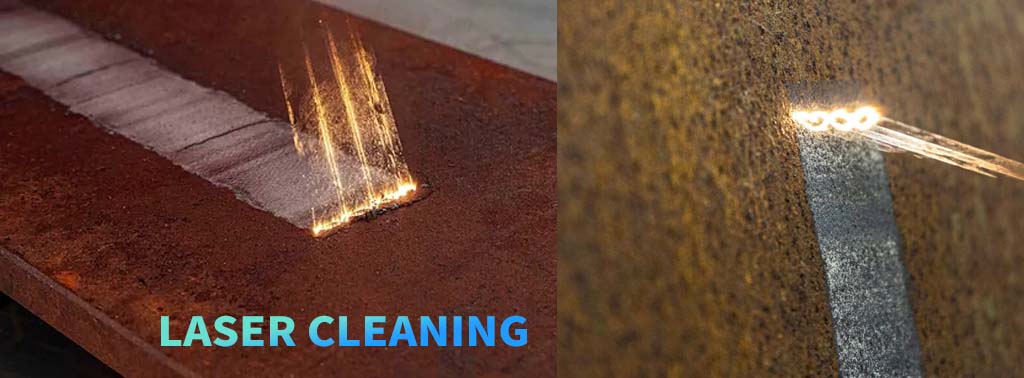
Start with the job, not the wattage. Tell the supplier whether you need to remove rust, corrosion, paint, oxide, weld discoloration, oil, grease, powder coating, carbon deposits, mold residue or other production contamination. A machine that performs well on light surface rust may not be the best choice for thick paint on structural steel, while a high-power machine designed for aggressive rust removal may be unnecessary for delicate mold cleaning.
A serious supplier should ask about both the contamination and the substrate before recommending a machine. If the first question is simply “What power do you want?”, they are recommending equipment before understanding the application.
2. Should I choose a pulsed or CW laser cleaner?
This is one of the biggest buying decisions. A pulsed laser cleaning machine is generally the stronger starting point when precise cleaning, low heat input, mold cleaning, weld cleaning, selective coating removal or preservation of the original surface matters. CW systems are generally more attractive for heavy rust, thick coatings and large steel surfaces where square meters per hour matter more than fine surface control.
Neither technology is universally better. Ask the supplier to explain why they recommend pulsed or CW for your contamination, substrate and required finish, rather than treating one technology as a premium upgrade for every application.
3. What power level do I actually need?
More power does not automatically mean a better purchase. Required power depends on contamination thickness, cleaning area, substrate sensitivity, target speed and daily workload. Light oxidation or weld discoloration can require a very different system from thick corrosion across large steel structures.
Instead of asking whether 500W is “better” than 300W, ask: “What cleaning speed and final surface condition can I expect on my actual part at each power level?” That turns wattage into something commercially meaningful.
4. Will you test my actual parts before I buy?
This is one of the most important questions on the list. Do not make a buying decision only from clean factory demo plates or short before-and-after videos. Send the supplier your actual part or a representative sample and provide the material, contamination type, approximate layer thickness, cleaning area, current cleaning method and required final surface.
Before purchasing a laser cleaner for metal, ask the supplier to show which machine was used, how many passes were required, approximate cleaning time and what the metal looked like afterward. A real sample test tells you much more than another specification sheet.
5. What cleaning speed can I realistically expect?
Maximum scanning speed is not the same as real cleaning productivity. Actual output depends on contamination thickness, number of passes, scan width, part geometry, operator movement and the required finish. Ask for productivity in m²/h or parts/hour on an application similar to yours.
For example, ask how long it takes to clean one of your molds, how many square meters of your rust level can be removed per hour, or how many passes your coating requires. A cheaper machine that takes twice as long on every job may be more expensive in practice.
2. Will the Machine Work Efficiently in My Shop or on My Job Sites?
6. Is the machine portable enough for my work?
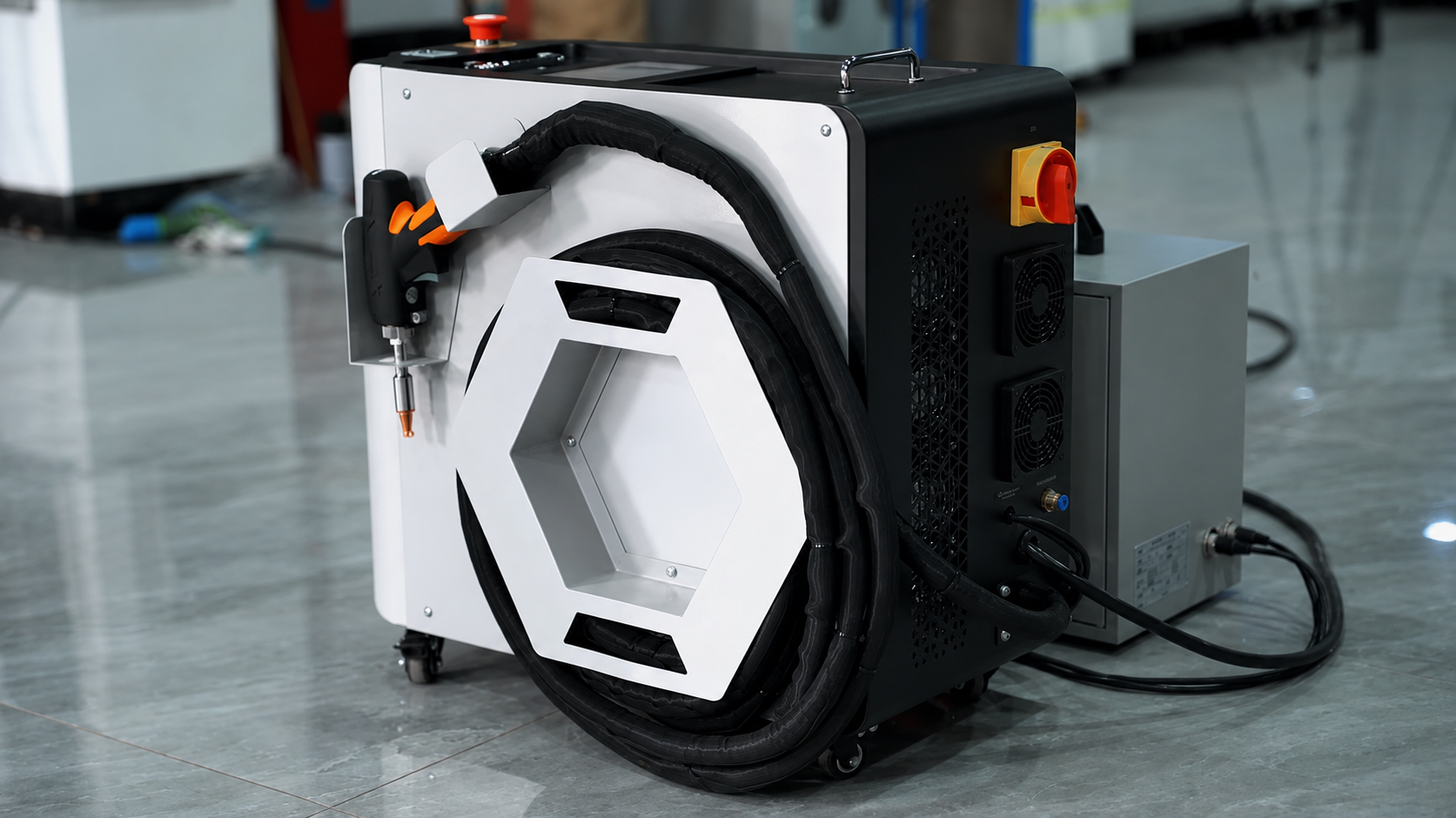
If you clean vehicles, molds, tanks, pipes, machinery or fixed structures, portability matters. Ask for machine size and weight, cleaning-head weight, fiber-cable length, packing dimensions and how easily the system can be loaded and moved.
For contractors and mobile service businesses, a portable laser cleaner that is easy to move between jobs may create more value than a heavier machine with slightly higher maximum power. Cleaning-head weight matters too, because an operator may hold it for hours during a shift.
7. Is it air-cooled or water-cooled, and how long can it run?
Cooling should match your working schedule. Ask whether the machine is air- or water-cooled, how long it can operate continuously, what ambient temperature range is recommended and whether output is reduced when the machine becomes too hot.
Compact air-cooled machines are attractive for mobile and intermittent work because they simplify transportation. Water-cooled systems may be more suitable for higher power and longer continuous operation. Describe how many hours per day you actually expect to clean rather than choosing cooling type from a generic “air is better” or “water is more industrial” claim.
8. What cleaning head, scan width and modes are included?
The cleaning head determines a large part of the real operating experience. Ask about its weight, adjustable scan width, available scan patterns and whether frequently used settings can be saved.
A wider cleaning field can improve productivity on large surfaces, while tighter control is useful around edges, weld zones and small parts. If you clean several contaminants, a good laser rust removal machine should also make it easy to save separate recipes for rust, paint, oxide, molds and weld cleaning rather than rebuilding every parameter from zero.
9. What safety equipment and fume extraction do I need?
Industrial laser cleaners require appropriate laser safety procedures, and the exact requirements depend on the machine and local regulations. Ask for the machine's laser classification and what protective eyewear, controlled working area, barriers, emergency controls and operator training are required.
Also remember that removed contamination becomes smoke, fumes or particles. Rust, paint, oil and plated coatings do not generate the same emissions, so ask what extraction system is appropriate for the material you are actually removing. If you clean old paint or unknown coatings regularly, fume extraction should be part of the equipment plan from the beginning.
10. What daily maintenance and consumables will I need?
Laser cleaning is often promoted as “no consumables,” but a better description is low recurring consumable dependence. You may not need abrasive media or chemical stripper, but protective lenses, optical windows, filters, cooling components and extraction filters still require inspection or replacement.
Ask the supplier what normal daily and weekly maintenance involves, what is likely to need replacement during the first two years and how much those parts cost. This gives you a much more realistic view of ownership than assuming the machine requires no maintenance at all.
3. Can I Trust the Supplier and the Total Cost?
11. What laser source and major components are used?
You do not need to become a laser engineer, but you should know the brand and model of the laser source, cleaning head, control system and cooling system. Ask what warranty applies to each major component and whether replacements will still be available several years from now.
Component brand alone does not determine machine quality, but knowing what is inside the system makes quotations easier to compare and future maintenance much easier to plan.
12. What training and technical support are included?
A powerful industrial laser cleaning machine can still produce poor results if the operator does not understand how power, frequency, scan speed and cleaning patterns interact. Ask whether installation guidance, operating training, parameter recommendations, safety training, maintenance training and remote troubleshooting are included.
Also ask what happens when you encounter a new material six months later. Can the supplier help you develop a starting recipe, or does technical support end once the machine is delivered? For first-time buyers, this can be just as important as the hardware.
13. What exactly does the warranty cover, and how quickly can I get spare parts?
Do not stop at “one-year” or “two-year warranty.” Ask whether the laser source, cleaning head, control board, optics and cooling components are covered, and which items are treated as consumables.
Then ask about the process after a failure. Can the supplier diagnose the problem remotely? Are critical spare parts stocked? How quickly can protective lenses, boards or head components be shipped? Downtime often costs more than the replacement component, so service capability should influence the buying decision.
14. What exactly is included in the quotation?
Ask for an itemized quotation covering the main machine, cleaning head, fiber cable, cooling system, protective lenses, safety equipment, extraction system, spare parts, training, packaging and shipping. The most useful question is: “What else will I need to buy before I can complete my first real cleaning job?”
Also confirm production lead time, shipping method, installation procedure and how the machine will be tested when it arrives. A low headline price becomes less attractive if essential accessories and support have been removed from the package.
15. What is the total cost, and how long will it take to pay back?
Finally, calculate the complete investment rather than comparing machine price alone.
Total Initial Investment = Machine + Accessories + Extraction + Safety + Shipping + Installation
Then calculate:
Payback Period = Total Initial Investment ÷ Monthly Net Savings
Your monthly savings should compare the laser against your current process, including labor, abrasive media, chemicals, dry ice, waste disposal, masking, cleanup, equipment rental, downtime and rework.
For LaserCleanerPro, most standalone machines are below US$15,000, while a dual-axis multi-mode handheld laser cleaner is around US$4,300, so ROI should be calculated from the actual configuration you need rather than assuming all industrial laser cleaners require a very high capital investment.
If a supplier says, “The machine pays for itself in six months,” ask what cleaning volume, labor rate and current process cost they used. If they cannot explain the assumptions, the ROI number is only a sales claim.
Conclusion
The best laser cleaning machine is not automatically the one with the highest wattage, lowest price or most impressive demonstration video. It is the machine that fits your contamination, substrate, required surface finish, cleaning area, daily workload and budget.
Before buying, focus on five things: test your actual workpiece, choose pulsed or CW based on the application, verify realistic cleaning productivity, confirm training and spare-parts support, and calculate ownership cost using your own numbers.
A professional laser cleaning machine should solve a specific cleaning problem rather than simply add another piece of equipment to your shop. Before requesting a final quote, send LaserCleanerPro photos or samples of your parts together with the substrate, contamination type, approximate layer thickness, cleaning area, current cleaning method and expected workload. The team can test the application and recommend a pulsed or CW configuration based on the cleaning result and productivity you actually need.