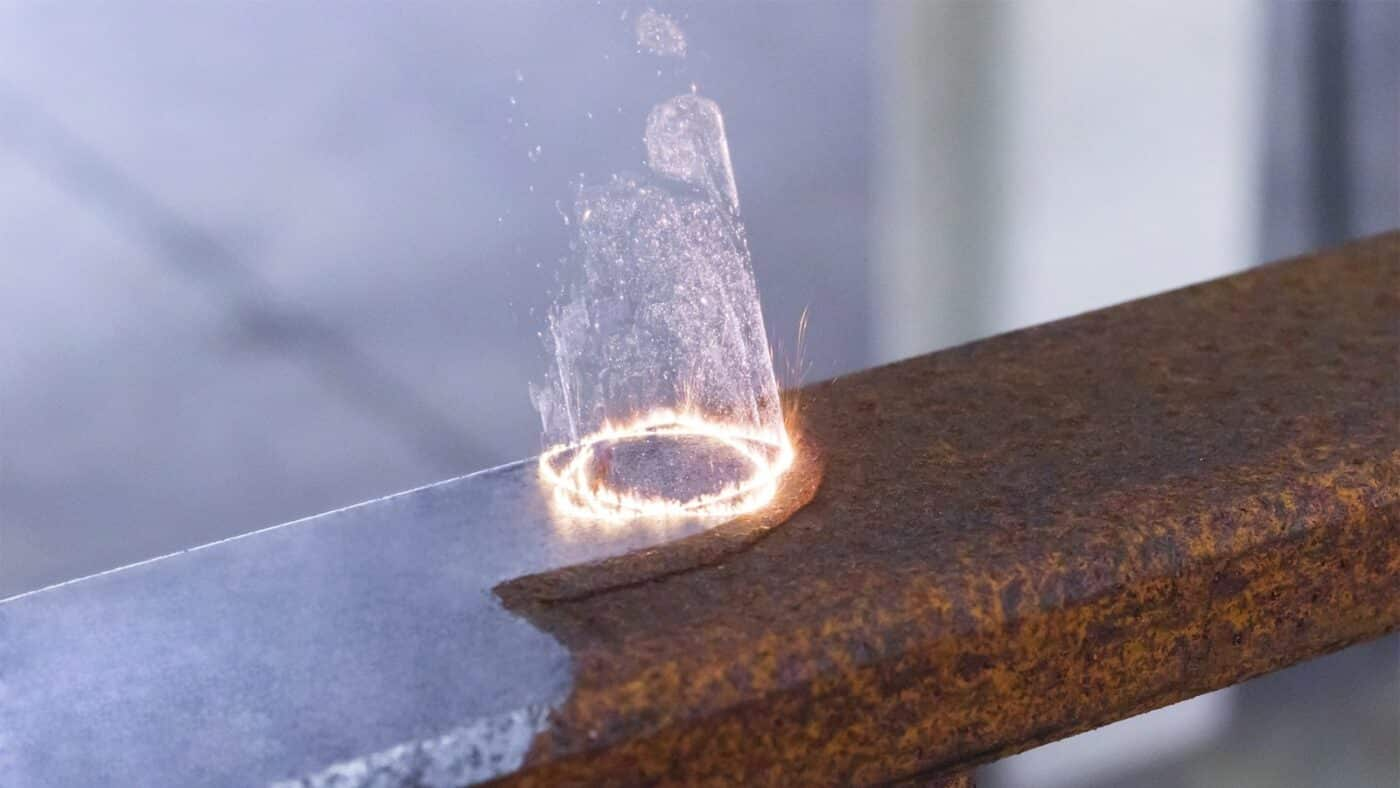
A laser cleaner can remove far more than rust.
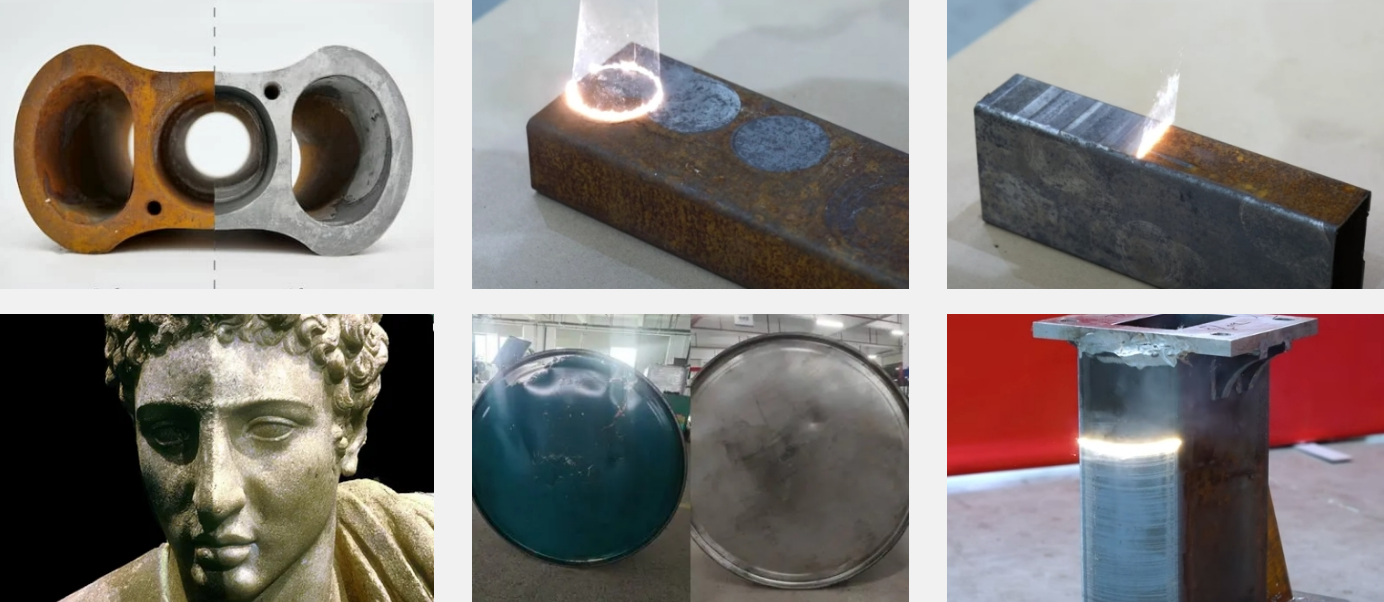
Depending on the laser type, power, contamination thickness and substrate, industrial laser cleaning can be used for rust, oxide layers, paint, powder coating, oil films, grease, weld discoloration, mill scale, carbon deposits, mold residue, adhesives and other surface contamination.
But not every laser cleaner handles all of these jobs equally well.
A low-power pulsed machine designed for precision molds is very different from a high-power continuous-wave system used on thick rust and large steel structures.
The practical rule is:
Pulsed laser cleaning is usually better when surface control matters.
Higher-power pulsed or CW cleaning becomes more attractive when contamination is thicker and production speed matters more.
So the right question is not simply:
“Can a laser remove this?”
It is:
“Which laser configuration can remove this contamination at the required speed without unnecessarily changing the material underneath?”
1. What Can a Laser Cleaner Remove?
The five most common industrial applications are rust, paint, oxide, oil and coatings.
Contamination | Can Laser Cleaning Remove It? | Best Starting Point | Main Consideration |
|---|---|---|---|
Rust / corrosion | Yes | Pulsed for precision; CW for heavy rust | Rust thickness and required finish |
Paint / primer | Yes | Pulsed for selective removal; CW for larger areas | Coating thickness |
Oxide / weld discoloration | Yes | Pulsed | Substrate sensitivity |
Oil / thin grease | Yes | Pulsed | Thick grease may need pretreatment |
Powder coating / functional coatings | Yes | Pulsed or CW depending on thickness | Coating and substrate compatibility |
Mill scale | Yes | Higher-power pulsed or CW | More energy / multiple passes |
Carbon / soot | Yes | Pulsed | Deposit thickness |
Mold residue | Yes | Pulsed | Preserve mold texture |
Adhesive residue | Often | Pulsed | Material and adhesive chemistry |
This range is why a laser cleaning machine for rust and oxide removal can often be used for several processes inside the same factory rather than one single cleaning task.
The important point is that “removable” does not mean “one pass at any wattage.”
Contamination thickness and substrate condition determine how practical the process is.
2. How Laser Cleaning Handles Rust, Paint, Oxide, Oil and Coatings
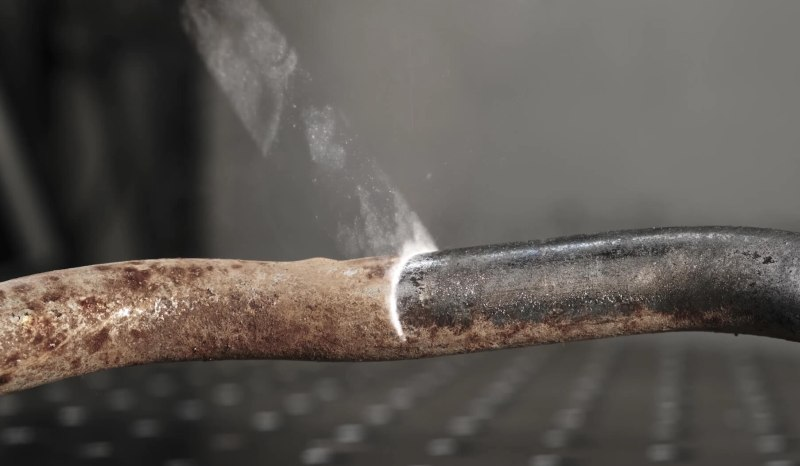
Rust and corrosion are the most familiar laser-cleaning applications.
Light surface rust, flash rust and localized corrosion can often be removed very efficiently with a pulsed laser. This is especially useful on molds, tooling, automotive components, weld zones and machinery where abrasive damage is undesirable.
As corrosion becomes thicker and more heavily scaled, productivity becomes increasingly important. A higher-power laser rust remover for metal or CW system can become more suitable for large steel components, pipes, tanks and structural surfaces.
The original article correctly distinguishes light surface corrosion from heavier rust requiring more power or repeated passes.
The key buying mistake is choosing a low-power precision machine for large areas of heavy corrosion simply because both machines are marketed as “laser rust removers.”
Light rust and heavy scale are different production problems.
Paint and primer can also be removed with laser cleaning.
The laser energy is absorbed by the coating, allowing it to break down and separate from the underlying material.
For automotive panels, precision components and selective refinishing, pulsed laser cleaning can provide better control because the operator can remove paint from a defined area without mechanically sanding the whole component.
For thicker paint, multiple coating layers and large steel structures, higher-power equipment becomes more important.
A laser paint removal machine for metal surfaces is therefore particularly useful when selective stripping matters—for example, exposing only a weld area, bonding zone or repair section while leaving nearby coating intact.
That is an important advantage over methods that naturally treat a much larger area.
However, very thick or heavily aged coating systems may require several passes. On very large surfaces, abrasive blasting or another high-throughput process can still be economically attractive.
Oxide layers and weld discoloration are another strong laser-cleaning application.
Stainless steel welds commonly develop blue, purple, brown or darker heat tint around the weld zone. Aluminum, titanium and other metals can also develop oxide layers that need to be removed before further manufacturing or finishing.
A laser cleaner machine for weld oxide and surface preparation can remove these localized oxide layers without the same mechanical contact associated with grinding or abrasive cleaning.
This is particularly useful for:
Weld preparation.
Post-weld cleaning.
Precision fabrication.
Automotive components.
Stainless steel processing.
Tool and mold maintenance.
Parameter control matters because removing oxide from stainless steel is not exactly the same task as cleaning aluminum or titanium.
The metal itself, surface finish and desired final condition all affect the correct process.
The original draft also covers mill scale and denser oxide layers separately, which is useful because they are generally more demanding than thin weld discoloration.
Oil, lubricant and thin grease films can also be treated with laser cleaning.
This application is especially useful when the objective is to prepare a localized surface before welding, bonding, coating or another manufacturing process.
Laser cleaning can remove thin organic contamination without introducing abrasive media or liquid cleaning chemicals directly onto the part.
A laser cleaner for oil and grease removal can be useful for gears, bearings, molds, machined parts and metal components where localized degreasing is needed.
However, there is an important distinction between:
Thin surface contamination
and
Thick, wet grease deposits.
Laser cleaning is much more attractive for thin films, baked residues and controlled surface preparation.
If a component is covered in a heavy layer of wet oil or grease, removing the bulk contamination first can be more efficient than asking the laser to process the entire volume.
In those situations, the best workflow may be:
Bulk degreasing → laser final cleaning
rather than laser cleaning alone.
Powder coatings and other functional layers can also be removed, but this requires more careful process matching.
Paint, powder coating, varnish and some anodized or plated layers can be selectively treated with laser energy.
This makes a laser coating removal system for metal parts useful for applications such as:
Masking-free selective stripping.
Electrical contact preparation.
Repair zones.
Rework.
Restoration.
Weld preparation.
Removing coating from only a specific area can be much more efficient than stripping and refinishing an entire component.
But functional coatings require testing.
Anodizing, nickel, chrome and other engineered surface layers behave differently from ordinary paint.
The objective may also be very different: sometimes you want to remove the coating completely, while other applications require removing only the top layer without changing the material underneath.
This is why sample testing becomes especially important for coating-removal work.
3. What Determines Whether a Laser Cleaner Works Well?
The contaminant name alone does not determine performance.
Two parts may both have “rust,” but one has a thin orange film and the other has thick flaky corrosion.
They should not be treated as the same job.
The most important factors are contamination thickness, substrate, required finish, cleaning area and laser configuration.
Contamination Thickness
Thin contamination usually requires less energy and fewer passes.
As rust, paint, carbon or coating thickness increases, you may need more power, slower scanning or repeated passes.
This is one reason suppliers should ask for more information than:
“What material is it?”
They should also ask:
How thick is the contamination?
Substrate
Laser cleaning depends on the difference in how the contamination and underlying material interact with the laser.
Steel, stainless steel, aluminum, copper, titanium, mold steel and other materials do not all respond identically.
A setting that works well on carbon steel should not automatically be copied onto aluminum.
For high-value or heat-sensitive components, pulsed systems typically provide a wider control window.
Surface Area
A 10 cm weld seam and a 200 m² steel structure may contain exactly the same type of rust, but they require very different equipment.
For a small repair area, precision and portability may matter most.
For large structures, square meters per hour becomes much more important.
This is where higher-power CW configurations can offer a stronger production advantage.
Required Finish
Do you simply need the rust gone?
Or does the part need to be ready for:
Painting?
Welding?
Bonding?
Inspection?
Precision assembly?
Coating?
The required final surface matters.
For example, laser cleaning machine can leave a clean surface while largely preserving the original texture, which is attractive for precision parts.
But if a coating specification requires an aggressive anchor profile, abrasive blasting may still be the better preparation method or may need to follow the laser process.
Pulsed vs CW
The decision between pulsed and continuous-wave cleaning is therefore fundamental.
A pulsed laser cleaner is generally a stronger starting point for precision components, molds, thin metals, selective coatings and surfaces where heat input needs tighter control.
A CW laser cleaner becomes more attractive for heavy corrosion, thick paint and large steel surfaces where cleaning throughput is the main objective.
Higher-end pulsed systems can also handle significantly heavier contamination than entry-level machines, so “pulsed” should not automatically be interpreted as only suitable for light cleaning.
The capability range expands as pulse energy, control, scan system and overall machine architecture improve.
4. When Is Laser Cleaning the Right Choice?
Laser cleaning is particularly attractive when the contamination must be removed without adding abrasive media or liquid chemical residue to the surface.
This makes it especially useful for repeated industrial maintenance, molds, precision components, weld preparation, automotive repair, restoration and localized cleaning.
Compared with sandblasting, laser cleaning generally produces much less secondary media waste because there is no continuous supply of grit being projected at the surface. The removed contamination still becomes fumes or particles, so suitable extraction is required.
Compared with chemical stripping, laser cleaning avoids immersing the component in a chemical bath or applying stripper directly to the workpiece.
The original article correctly frames the choice as application-specific rather than treating laser cleaning as a universal replacement for blasting or chemicals.
For precision and selective cleaning, laser usually deserves strong consideration.
For large structural surfaces requiring a rough coating profile, sandblasting may still make more sense.
For deep internal cavities and batch immersion work, chemical treatment can reach geometry that a line-of-sight laser cannot.
For heavy wet oil deposits, bulk degreasing before laser cleaning may be more efficient.
That does not reduce the usefulness of laser cleaning.
It helps define where it creates the most value.
Other Contaminants Laser Cleaners Can Handle
Beyond the five main categories, laser cleaners can also be used for several other types of industrial contamination.
These include carbon deposits, soot, smoke staining, mold-release residue, rubber residue, adhesive and label residue, production contamination and some surface scale.
The original article also identifies these additional applications.
For businesses handling mixed applications, this flexibility can matter more than maximum rust-removal speed.
One machine may be used for rust in the morning, mold residue later in the day and weld cleaning on another production line.
That is where an industrial laser cleaner for rust, oxide and surface contamination becomes more than a single-purpose rust-removal tool.
Conclusion
A laser cleaner machine can remove a wide range of industrial surface contamination, including rust, oxide, paint, oil films, grease, powder coatings, weld discoloration, mill scale, carbon deposits, mold residue and some adhesives.
But the effectiveness of the process depends on much more than the name of the contamination.
Light rust and heavy scale require different equipment.
Thin oil film and thick grease require different workflows.
Paint on an automotive panel and multiple coating layers on structural steel require different levels of power and control.
The most useful way to choose a machine is therefore:
Identify the contamination → identify the substrate → estimate the layer thickness → define the required finish → determine the cleaning area → choose pulsed or CW technology.
For precision components, molds, localized rust and sensitive surfaces, pulsed laser cleaning is usually the stronger starting point.
For heavier corrosion, thick coatings and larger steel surfaces, higher-power pulsed or CW systems can provide much higher productivity.
And in some applications, the most efficient solution is a combined process rather than laser cleaning alone.
The right laser cleaner is not the machine that claims to remove the most materials. It is the machine that removes your actual contamination at the required speed without unnecessarily damaging or changing the substrate.
Not sure whether your contamination is suitable for laser cleaning? Send LaserCleanerPro photos or samples of your part, together with the substrate, contamination type, approximate layer thickness and expected workload. The engineering team can arrange an application test and recommend a suitable pulsed or CW configuration based on the cleaning result you actually need.