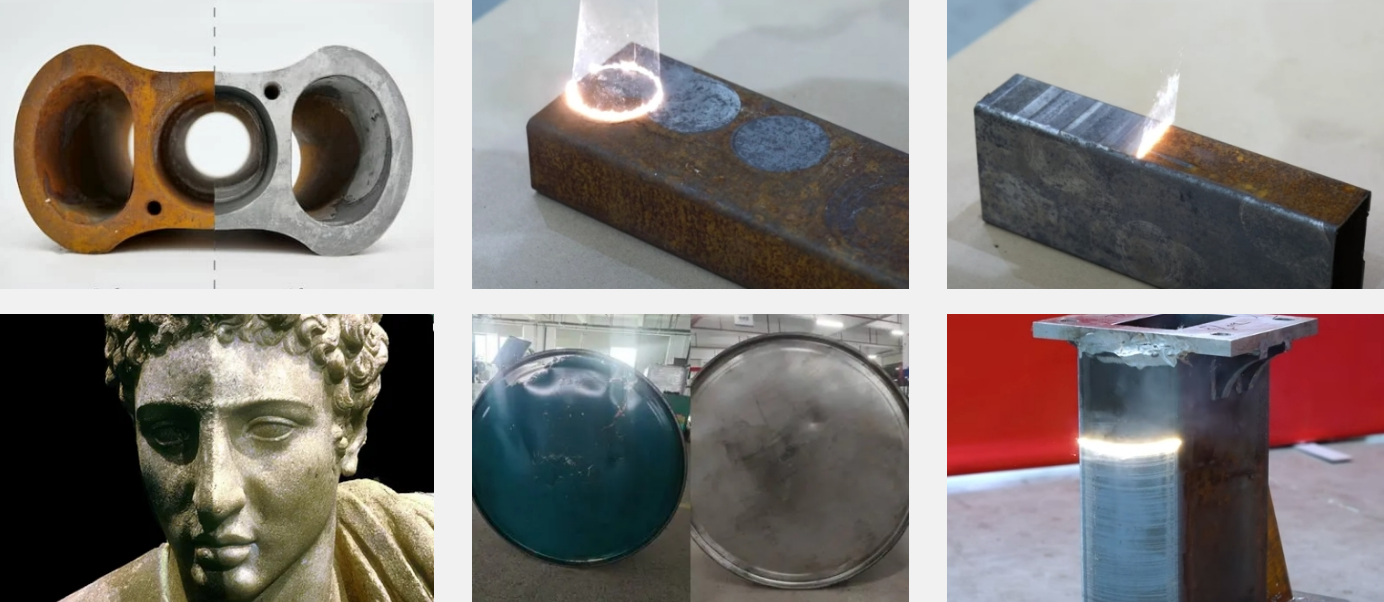
Laser cleaning can remove anything from light surface oxidation to heavy rust and industrial coatings, but there is no single answer to:
“How many square meters can a laser cleaner clean per hour?”
The same machine might clean light oxidation quickly but slow down significantly on thick rust or multilayer paint.
In practice, cleaning speed depends mainly on:
What you are removing.
How thick or severe it is.
Whether you use a pulsed or CW laser.
How clean the surface needs to be afterward.
How many passes are required.
For buyers comparing a laser cleaning machine, this means advertised m²/h should always be treated as an application-specific number—not a fixed machine speed.
A useful planning guide looks like this:
Typical Application | Common Power Direction | Practical Speed Expectation |
|---|---|---|
Light rust / thin oxide | 100–300W pulsed | Lower-to-medium throughput, typically a few m²/h |
Weld oxide / precision cleaning | 100–300W pulsed | Usually a few m²/h, depending on required finish |
Moderate rust / coatings | 300–500W pulsed | Several m²/h; multiple passes may be needed |
Large-area rust removal | 1000–1500W CW | Often around 10–25 m²/h on suitable surfaces |
Heavy rust / large steel structures | 2000–3000W CW | Can reach tens of m²/h under suitable conditions |
Thick or multilayer paint | Depends heavily on coating | Often much slower than light rust |
These are planning bands, not guaranteed production speeds.
A supplier quoting one number such as:
“This machine cleans 20 m²/h.”
without asking what material, rust thickness or coating you have is giving you an incomplete answer.
1. How Fast Is Laser Cleaning for Rust, Paint and Oxide?
The contaminant has a bigger effect on cleaning speed than many first-time buyers expect.
Rust Removal
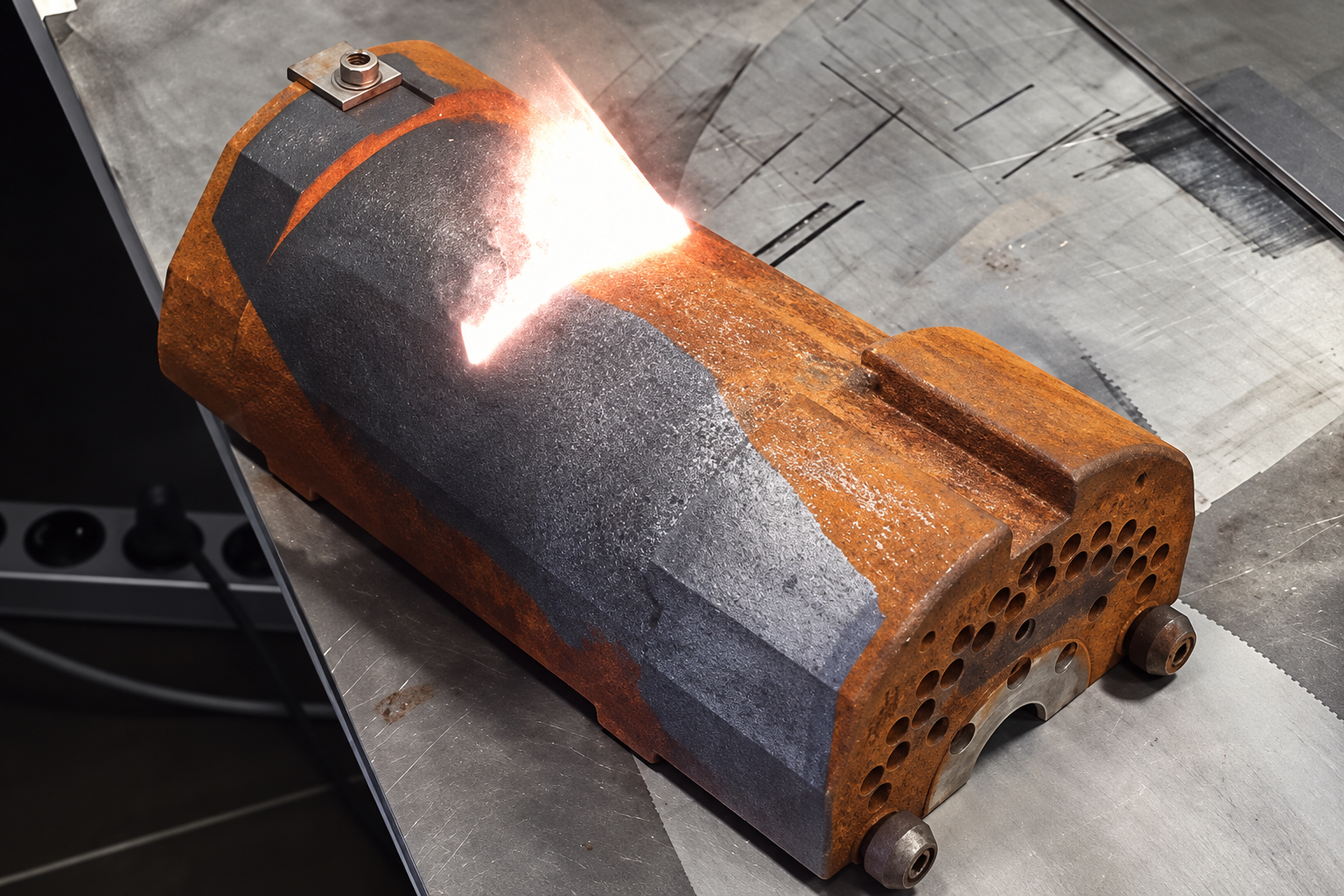
Light surface rust is usually one of the easier laser-cleaning applications.
A low- to medium-power laser rust removal machine can remove light oxidation relatively quickly because only a thin surface layer needs to be ablated.
As rust becomes thicker, flaky or deeply developed, the machine may need:
More energy.
Slower scanning.
Greater overlap.
Multiple cleaning passes.
That reduces m²/h quickly.
The original draft illustrates this well: the same 300W pulsed system can operate much faster on light rust than on a thicker corrosion layer requiring several passes.
So instead of asking:
“How fast is a 300W laser cleaner?”
ask:
“How fast is a 300W laser cleaner on my rust condition?”
That is a much more useful question.
Typical Rust Cleaning Direction
For practical machine selection:
100–200W pulsed
Best suited to light oxidation, small parts, delicate substrates and lower-volume precision work.
300–500W pulsed
Better for shops that need higher throughput while still prioritizing controlled surface treatment.
1000–1500W CW
More suitable when rust removal covers larger areas and production speed matters more than extremely fine surface control.
2000–3000W CW
Better suited to large steel structures, heavy industrial maintenance and jobs where square meters per hour are the main priority.
This is why a small pulsed laser cleaner and a 2000W CW machine should not be compared by wattage alone.
They are often intended for different jobs.
Paint and Coating Removal
Paint removal is more difficult to predict than light rust removal.
Two painted steel panels can require very different cleaning times because one may have a thin single coating while another has several layers of primer, paint and protective coating.
Important variables include:
Coating thickness.
Number of layers.
Coating chemistry.
Bond strength.
Substrate material.
Required final surface.
For thin coatings, laser cleaning can be relatively fast.
For thick industrial paint stacks, speed can drop sharply because the machine may need several passes before reaching bare metal.
The original data shows this same pattern: increasing coating thickness substantially lowers effective removal speed even when machine power remains unchanged.
This means paint thickness should be included in every serious speed test.
If your supplier only demonstrates a lightly painted sample and you need to remove thick marine or industrial coatings, that demo does not tell you enough.
Oxide Removal
Oxide removal is often less about removing a large volume of material and more about achieving the correct surface condition.
Typical applications include:
Pre-weld cleaning.
Post-weld oxide removal.
Aluminum oxide removal.
Stainless-steel discoloration.
Surface preparation before bonding.
For these jobs, a laser cleaner for metal may deliberately run slower than its theoretical maximum because the goal is not simply to expose bare metal as quickly as possible.
The operator may need to preserve:
Surface roughness.
Dimensions.
Appearance.
Coating underneath.
Weld geometry.
That is why precision oxide removal is usually a better fit for pulsed systems.
For a production customer, the useful measurement is often not only m²/h.
It may be:
Seconds per weld.
Seconds per component.
Parts per hour.
If your factory needs to clean a 20 mm-wide weld zone on 1,000 components per shift, “square meters per hour” is not even the most useful productivity metric.
2. Why Can the Same Laser Cleaner Have Very Different Speeds?
Laser power matters, but it is only one part of cleaning speed.
This is one of the most important things buyers should understand before choosing equipment.
Contamination Thickness
This is usually the first variable.
Removing 20 µm of oxidation is not the same job as removing a thick layer of rust or several coats of paint.
Thicker contamination normally means:
More energy required.
More passes.
Lower travel speed.
Lower real m²/h.
Number of Passes
A supplier may quote a very fast single-pass scanning speed.
But if the surface requires three passes to meet your acceptance standard, your real production rate can be roughly one-third of what that first-pass number suggests.
Always ask:
How many passes were required to achieve the quoted speed?
Pulsed vs CW Laser
This also changes the type of speed you should expect.
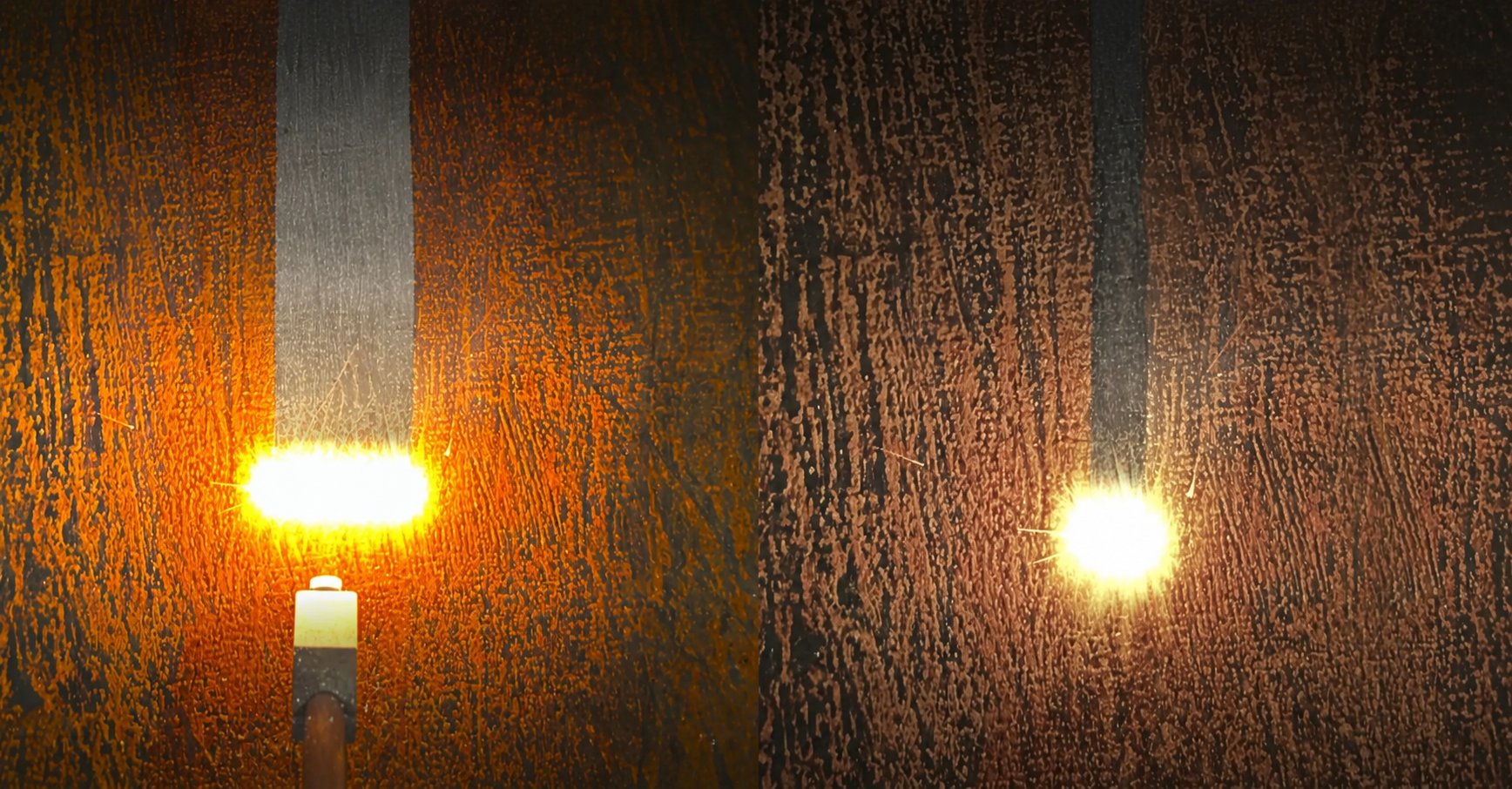
A pulsed laser cleaner concentrates energy into short pulses. It is often chosen for controlled cleaning, precision surfaces, molds, oxide removal and applications where substrate protection matters.
A CW laser cleaner delivers continuous energy and is generally used when removing heavier contamination over larger, robust metal surfaces where throughput is the priority.
So a 300W pulsed machine should not be judged as “slow” simply because a 2000W CW machine covers more square meters per hour.
The pulsed machine may be solving a much more sensitive cleaning problem.
Scan Width
A wider cleaning path can cover more area per movement.
But simply increasing scan width does not guarantee the same cleaning quality.
If the energy is spread across too large an area, the machine may need:
Lower movement speed.
More overlap.
Additional passes.
Again, actual productivity is a balance rather than one parameter.
Surface Shape and Access
Cleaning a large flat steel plate is very different from cleaning:
A complex mold.
A machine corner.
Curved pipe.
Weld seams.
Automotive parts.
A tight internal structure.
A portable laser cleaner working on complex parts may spend significant time repositioning even if the laser itself scans quickly.
That reduces effective hourly throughput.
Required Final Result
“Rust removed” can mean different things.
One customer may only need visible loose rust removed.
Another may require a clean surface suitable for:
Welding.
Bonding.
Painting.
Coating.
Inspection.
The stricter the required surface condition, the more likely the process will need additional passes or slower settings.
More Power Does Not Automatically Mean Proportionally More Speed
This is another area where the original article is directionally correct.
Doubling laser power does not always double production throughput. Scan width, absorption, overlap, pass count and contamination severity also limit the usable cleaning rate.
That is why buying the highest wattage available is not always the best decision.
The correct goal is:
Enough power to meet your required throughput without unnecessarily sacrificing surface control or increasing machine cost.
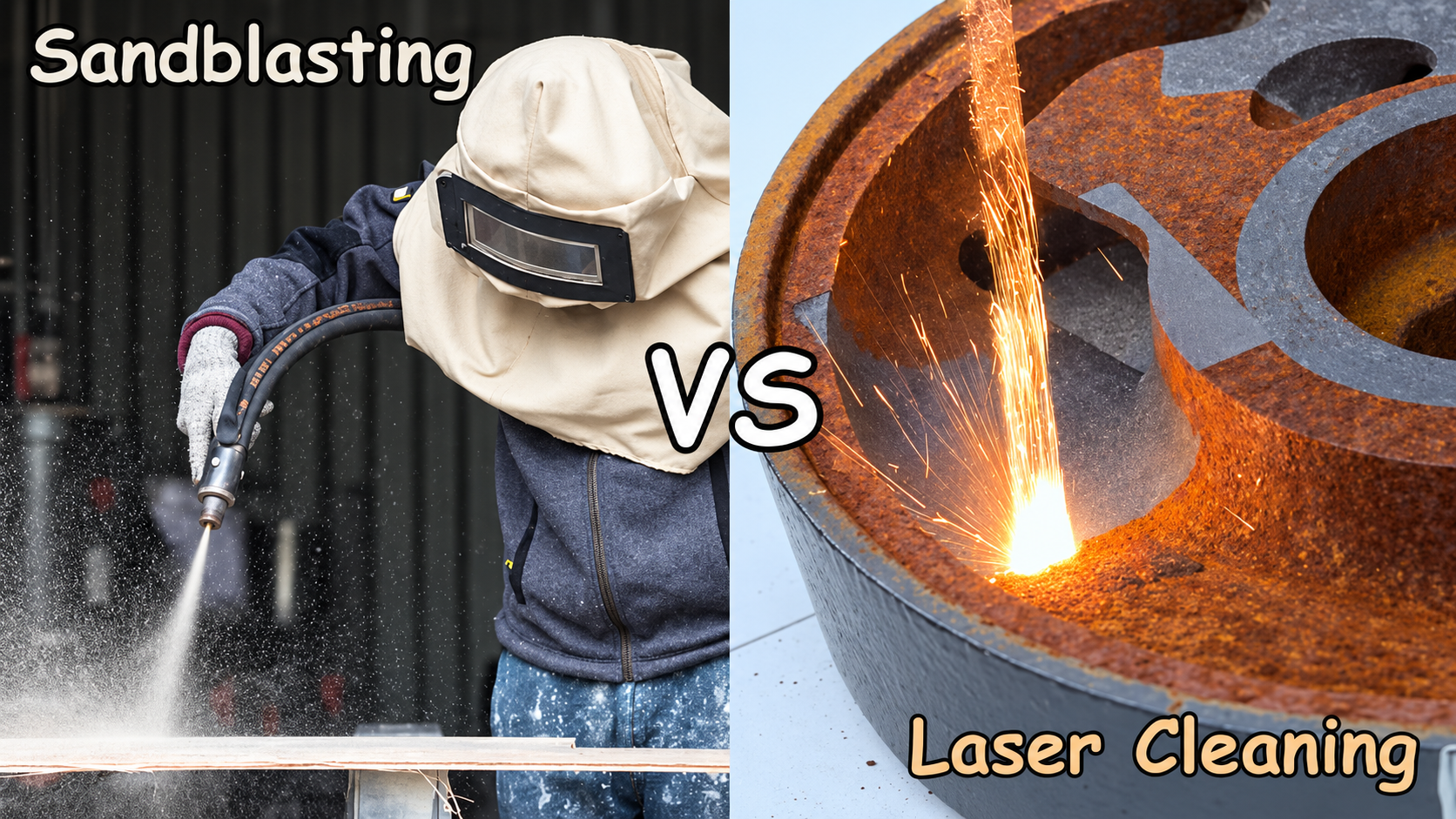
Is Laser Cleaning Faster Than Sandblasting?
Sometimes yes, sometimes no.
For very large, open steel surfaces with heavy rust or mill scale, abrasive blasting can still achieve very high raw area coverage.
Laser cleaning becomes particularly attractive when the full process includes:
Media preparation.
Masking.
Cleanup.
Spent abrasive disposal.
Dust management.
Moving parts to and from a blasting area.
Chemical handling.
Abrasive contamination.
The original draft correctly notes that sandblasting can retain a raw speed advantage on large, uniform structural steel, while laser cleaning becomes more competitive on precision areas, complex geometry and jobs where cleanup matters.
So compare total job time, not just beam-on cleaning speed.
3. What Laser Power Do You Need for Your Required Cleaning Speed?
For buyers, this is ultimately the most useful part of the speed discussion.
Do not start with:
“Should I buy 200W or 300W?”
Start with:
“What do I need to clean, and how much of it must I clean per shift?”
Then work backward.
A Practical Selection Guide
Your Main Requirement | Starting Direction |
|---|---|
Small parts, molds, light oxide | 100W pulsed |
Light rust, weld cleaning, general precision work | 200W pulsed |
Mixed jobs with more production demand | 300W pulsed |
Higher pulsed throughput | 500W pulsed |
Larger steel surfaces, moderate/heavy rust | 1000–1500W CW |
Industrial rust removal and larger structures | 2000W CW |
High-volume heavy steel cleaning | 3000W CW |
These are starting directions rather than universal rules.
If your workload is mixed, the correct machine depends on which jobs actually generate revenue.
For example:
A restoration shop cleaning delicate automotive parts may value precision more than maximum area speed.
A mold-cleaning business may prioritize minimal substrate change.
A shipyard or structural-steel contractor may care primarily about square meters per hour.
A manufacturing plant may care about seconds per part.
Different businesses need different definitions of “fast.”
Work Backward From Your Production Requirement
Suppose you need to clean:
100 m² per week.
You operate:
5 days per week × 5 productive cleaning hours per day = 25 hours.
Your required average rate is:
100 ÷ 25 = 4 m²/h
Now you have a useful procurement requirement.
Instead of asking suppliers:
“What is your fastest machine?”
ask:
“Can your machine sustain at least 4 m²/h on this exact contamination while producing this required surface finish?”
That is a much better buying question.
Ask for an Actual Sample Test
This is the most important recommendation in the article.
The original draft ends with the same basic principle: a speed claim is only useful when it is tied to the actual contamination, process settings and pass count.
Before buying an industrial laser cleaner, send the supplier your real sample whenever possible.
Ask them to record:
Material
Contamination type
Approximate rust or coating severity
Laser power
Cleaning width
Number of passes
Total cleaned area
Actual cleaning time
Final surface result
Then calculate:
Cleaning Rate = Cleaned Area ÷ Actual Cleaning Time
If a 2 m² sample takes 30 minutes:
2 ÷ 0.5 = 4 m²/h
That number is far more useful than a brochure saying:
“Up to 20 m²/h.”
Do Not Test Only the Fastest Setting
The supplier should show the final surface as well.
A machine that removes rust quickly but leaves:
Residual contamination.
Surface discoloration.
Excessive roughness.
Heat effects.
Unacceptable substrate damage.
has not completed the job just because the scanner moved quickly.
The correct cleaning speed is:
The fastest rate that still produces the surface condition you actually require.

Conclusion
So, how fast is laser cleaning?
There is no universal m²/h number.
Light rust and thin oxide can be removed relatively quickly, while thick corrosion, multilayer paint and demanding surface-preparation requirements can reduce throughput significantly.
As a general buying direction:
100–300W pulsed systems are better suited to precision cleaning, light rust, oxide removal and smaller areas.
300–500W pulsed systems provide more throughput while retaining the advantages of pulsed cleaning.
1000–3000W CW systems are better suited to larger steel surfaces, heavy rust and applications where area productivity is the main priority.
But power alone does not determine cleaning speed.
Rust severity, coating thickness, scan width, pass count, surface geometry and required final cleanliness all matter.
That is why the most useful question is not:
“How fast is this laser cleaner?”
It is:
“How fast will this laser cleaner clean my actual part to the result I require?”
Before purchasing a laser cleaning machine, send LaserCleanerPro photos or physical samples of the material you need to clean, along with the contamination type, cleaning area and required workload.
A real sample test can tell you the cleaning result, suitable power range and realistic throughput before you commit to the machine.