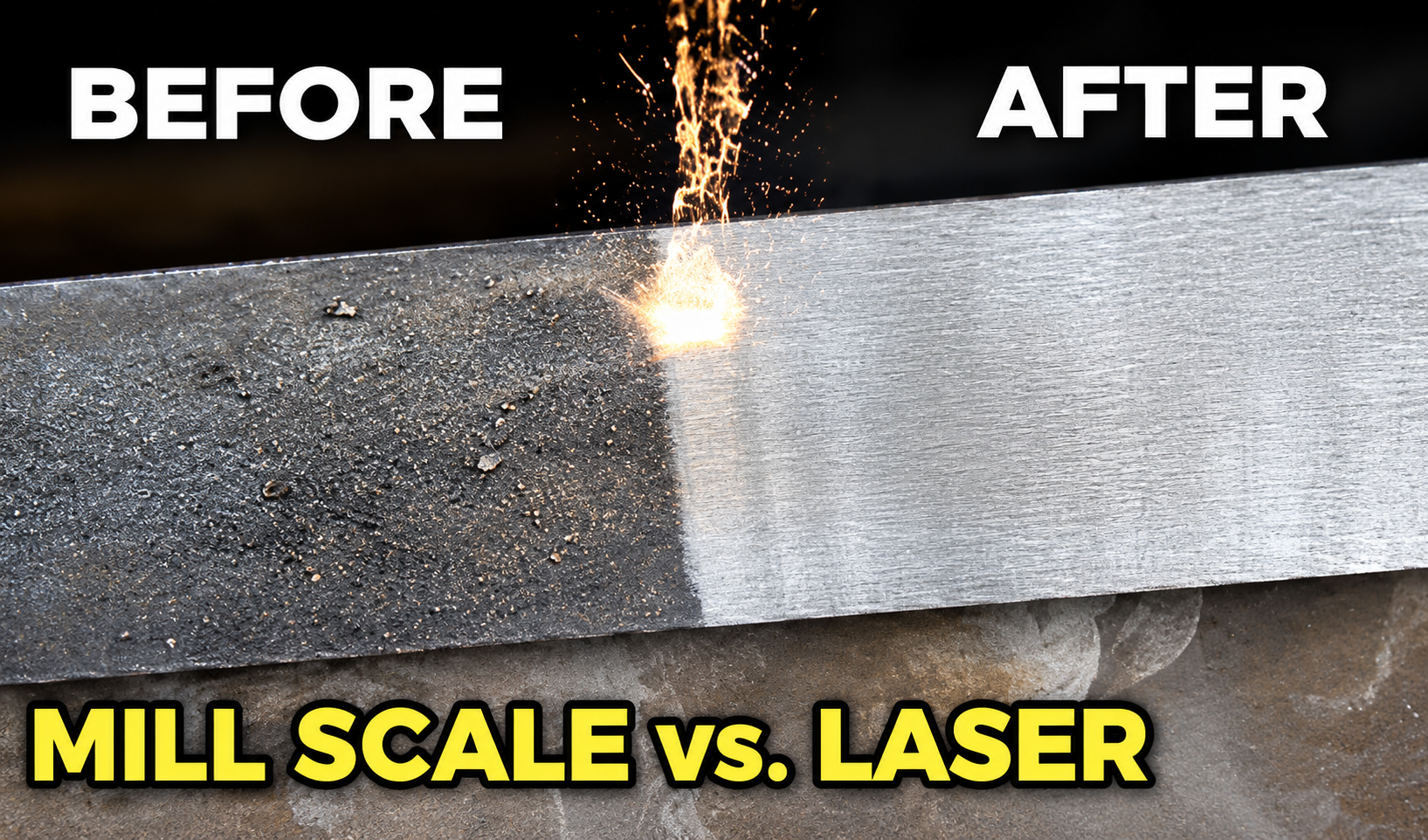
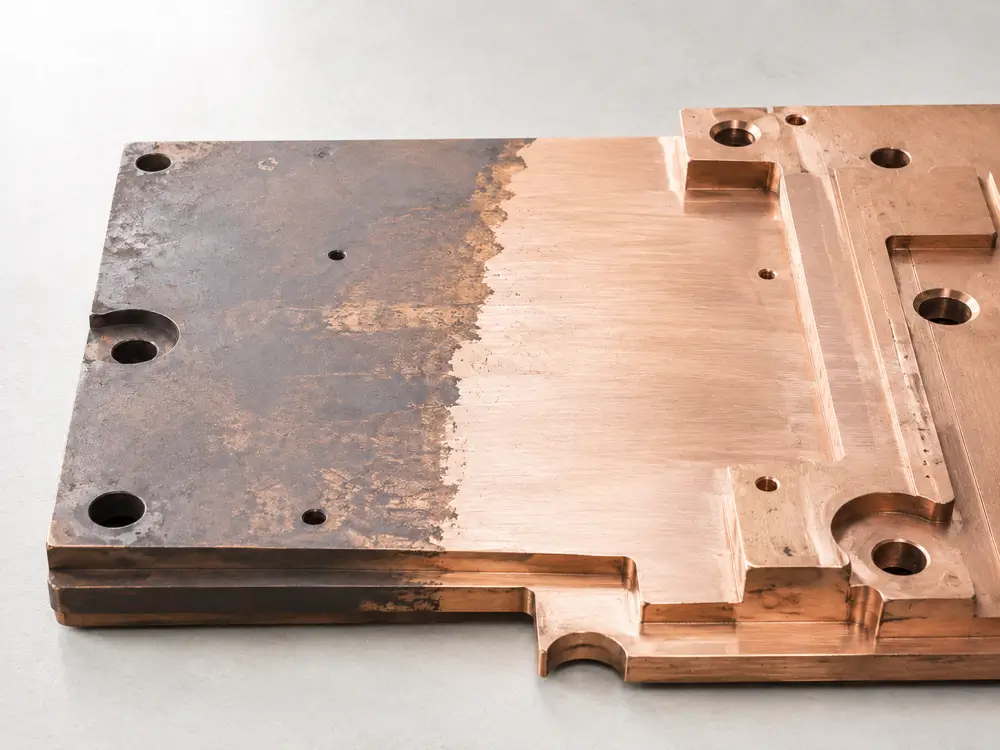
Can laser cleaning remove oxidation from copper without damaging the metal underneath? Yes. With a properly controlled process, laser cleaning can remove copper oxide and selected surface contaminants while limiting unwanted changes to the base metal.
Copper is widely used in electrical busbars, battery connections, industrial components, and manufacturing equipment. Over time, its surface can develop reddish-brown or black oxide layers, oil residue, and other contaminants that may interfere with welding, electrical contact, or further processing.
Traditional cleaning methods such as chemical treatment, grinding, and abrasive polishing can remove these deposits, but they may also involve additional handling, chemical disposal, or surface wear.
Laser cleaning offers a different approach. It uses focused laser energy to treat selected areas without direct mechanical contact or process water.
However, copper is more challenging to laser clean than many other metals because of its high reflectivity and thermal conductivity. Incorrect settings can cause blackening, melting, or unwanted surface changes.
This guide explains how to laser clean copper step by step, adjust cleaning parameters, avoid common problems, and determine whether a pulsed laser cleaner is suitable for your industrial applications.
1. Can Laser Cleaning Remove Oxidation from Copper?
Laser cleaning can remove copper oxide layers and certain surface contaminants, but the results depend on the type of deposit, surface condition, and laser equipment.
Before cleaning, it is important to identify what is actually present on the copper.
What Types of Copper Oxidation Can Be Removed?
Copper commonly develops two types of oxide layers.
Cuprous oxide (Cu₂O) typically appears reddish-brown and can form during normal exposure to oxygen.
Cupric oxide (CuO) is generally darker, often appearing dark brown or black. It may develop under different oxidation conditions, including heating.
Both oxide types can be removed under suitable laser processing conditions. However, their thickness, adhesion, and interaction with laser energy may differ.
Copper surfaces may also contain other contamination that requires a different cleaning approach.
Surface Condition | Typical Appearance | Laser Cleaning Suitability |
|---|---|---|
Light Cu₂O oxidation | Reddish-brown film | Often suitable after parameter testing |
CuO oxidation | Dark brown or black layer | May require additional process adjustment |
Oil and grease | Oily film or residue | Requires careful treatment to avoid carbonization |
Dust and processing particles | Loose surface deposits | Suitable for evaluation |
Heavy green corrosion | Green or blue-green deposits | Requires material and damage assessment |
Plated copper | Tin, nickel, or silver finish | High risk of damaging the intended coating |
For copper components used in electrical or manufacturing applications, removing oxidation may improve surface preparation before a subsequent operation. A laser cleaning machine supplier can explain which oxide, rust and coating tasks suit each system.
However, visible oxide removal does not automatically guarantee that the surface meets electrical, welding, or coating requirements.
Which Copper Surfaces Need Extra Care?
Thick copper plates and uncoated industrial components are generally easier to evaluate than extremely thin or coated parts.
Thin copper foil, plated terminals, fine electronic contacts, and parts containing solder or plastic components can be more sensitive to heat and laser exposure. A laser cleaner manufacturer can help you match parameters to these parts and avoid surface damage.
Likewise, copper objects with decorative or historically significant patina should not be cleaned unless removal of that surface layer is specifically intended.
If corrosion has already caused pitting, laser cleaning can remove suitable corrosion products but cannot restore metal that has been lost.
The goal is not simply to make copper look brighter. It is to remove unwanted contamination while preserving the surface properties required for the part's intended use.
2. How to Laser Clean Copper Step by Step
Successful copper laser cleaning begins with proper inspection and a representative test rather than immediately applying high laser power.
Because copper reflects much of the light from commonly used near-infrared fiber lasers, cleaning settings must be matched to the actual material and contamination.
The following process provides a practical approach for evaluating copper oxide removal.
Step 1: Inspect the Copper and Identify the Contamination
Start by confirming the copper grade or alloy, material thickness, surface finish, and intended application.
Examine the surface for reddish oxide, black oxidation, oil, dust, plating, or visible corrosion damage.
If the part will be welded, soldered, plated, or used as an electrical contact, determine the required surface condition before cleaning.
For example, a decorative copper panel may only need an acceptable visual finish, while an electrical connector may require more specific cleanliness and contact-resistance criteria.
This distinction helps prevent unnecessary processing.
Step 2: Prepare the Equipment and Work Area
For many localized industrial copper cleaning tasks, a pulsed fiber laser system is worth evaluating because its pulse and scanning controls allow the cleaning process to be developed around the surface.
Before operation, establish a suitable laser-controlled work area with beam containment, access restrictions, appropriate protective equipment, and effective local fume extraction.
Copper's reflective surface creates particular concerns about hazardous reflected laser radiation.
Inspect the equipment and cleaning head according to the manufacturer's instructions, and ensure that nearby sensitive components are adequately protected.
If the part contains significant oil or grease, consider appropriate preliminary degreasing. Heating organic contamination directly can sometimes leave carbonized residue instead of producing a clean surface.
Step 3: Perform a Small Test Cleaning
Choose an area representative of the production surface or use a matching copper sample.
Begin with a conservative condition within the equipment manufacturer's approved operating range.
Apply an initial controlled test pass, then inspect the surface before continuing.
Check whether the oxide layer has been removed and whether the copper shows any signs of discoloration, pitting, roughening, or melting.
Compare the cleaned area with an untreated reference.
If contamination remains, adjust the process gradually. Do not immediately increase to maximum laser power.
For workshops handling repeated copper oxidation problems, a pulsed laser cleaner with adjustable process controls may provide a useful alternative to manual abrasion or chemical cleaning, particularly when localized treatment is required.
Step 4: Adjust the Process and Clean the Target Area
Once the initial test shows acceptable results, fine-tune the process to achieve consistent removal.
Depending on the laser system, adjustments may involve pulse energy, frequency, pulse width, scanning speed, line spacing, or the number of passes.
Change one major variable at a time so its effect can be evaluated.
Maintain a consistent working distance and scanning pattern.
Avoid repeated exposure to already-clean areas, particularly around thin sections, sharp edges, and corners where local heating may become excessive.
If the surface begins turning black, developing visible pits, or showing unwanted texture changes, stop and reassess the settings.
Step 5: Inspect and Protect the Cleaned Surface
After cleaning, inspect the copper under consistent lighting.
Check for residual oxidation, loose particles, discoloration, and surface damage.
For industrial applications, visual inspection may need to be supplemented with measurements of roughness, surface chemistry, electrical resistance, or subsequent weld quality.
Clean copper can also oxidize again after exposure to air.
Where required, minimize handling and the delay between cleaning and the next manufacturing operation.
For example, copper parts prepared for welding should be transferred and handled according to the validated production procedure rather than left exposed unnecessarily.
A reliable cleaning process ends when the copper meets the required surface specification—not simply when it appears clean.

3. Copper Laser Cleaning Settings and Common Problems
Copper laser cleaning settings require more careful evaluation than many general-purpose metal cleaning tasks.
Clean copper reflects strongly at the near-infrared wavelengths used by many industrial fiber lasers.
At the same time, oxide layers, surface roughness, and temperature can change how much energy the material absorbs.
This makes it important to control the process rather than relying on a fixed parameter chart.
Which Laser Cleaning Parameters Matter Most?
Parameter | Effect on Copper Cleaning | What to Watch |
|---|---|---|
Laser Power | Influences available energy | Excessive energy may damage the copper |
Pulse Energy | Affects energy delivered per pulse | Must be matched to the contamination |
Pulse Width | Changes laser-material interaction | Can influence thermal effects |
Pulse Frequency | Controls pulse repetition | Must be coordinated with pulse energy and scan speed |
Scan Speed | Affects local exposure | Excessive dwell increases damage risk |
Scan Overlap | Influences uniformity and total exposure | Too much overlap may cause heat accumulation |
Number of Passes | Increases cumulative treatment | Repeated passes may alter the substrate |
The relationship between these settings matters more than any individual value.
For example, increasing pulse frequency on some systems can reduce the available energy per pulse at the same average power.
Similarly, reducing scan speed may increase the energy delivered to a given area, but it can also increase the risk of overheating.
There is no universal power, frequency, or scanning-speed combination that works on every copper alloy and oxide thickness.
Why Does Copper Turn Black After Laser Cleaning?
A black surface after laser treatment does not always mean the original contamination remains.
It can result from renewed surface oxidation, changes in the copper surface, or the redeposition of particles generated during laser processing.
This is one of the most important problems to understand when developing a copper cleaning process.
Instead of immediately repeating the cleaning cycle, examine the surface and review the settings.
Excessive local energy, slow scanning, repeated exposure, and inadequate particle extraction may contribute to unwanted blackening or surface modification.
The appropriate correction depends on the underlying cause.
Common Copper Laser Cleaning Problems
Problem | Possible Cause | Recommended Check |
|---|---|---|
Copper turns black | Re-oxidation or particle redeposition | Energy exposure, scan overlap, extraction |
Oxide remains | Insufficient or uneven cleaning | Focus, contamination type, scan coverage |
Surface develops pits | Excessive local energy | Pulse conditions and repeated exposure |
Uneven cleaning marks | Inconsistent scan pattern or working distance | Scanning alignment and focus |
Copper becomes rough | Surface melting or excessive ablation | Total energy exposure |
Contamination returns | Re-oxidation or handling contamination | Storage and post-cleaning workflow |
If the copper shows unwanted surface changes, increasing laser power is not automatically the solution.
The surface should be reassessed before continuing, particularly when the part has tight dimensional, electrical, or cosmetic requirements.
This is also why adjustable laser parameters and application-specific technical support matter when selecting a cleaning machine.
For companies processing different copper alloys or contamination levels, the ability to develop and repeat validated cleaning settings can be more valuable than simply choosing the highest available wattage.

4. Which Copper Applications Benefit Most from Laser Cleaning?
For industrial customers, the value of copper laser cleaning becomes clearer when it is connected to real manufacturing requirements.
The question is not only whether an oxide layer can be removed, but whether the cleaning process can improve the preparation, consistency, or handling of a specific component.
Copper Busbars and Electrical Connections
Copper busbars are widely used in electrical distribution equipment, energy storage systems, and industrial power applications.
Oxidation and surface contamination can be important when busbars must be joined or make reliable electrical contact.
Laser cleaning can be evaluated for localized preparation of uncoated busbar surfaces before selected joining or assembly operations.
For example, a manufacturer processing copper busbars may need to prepare the same defined area on every part before welding.
A controlled cleaning process may reduce the need for manual abrasive treatment and help standardize the preparation step.
However, the finished surface must still be tested for the required electrical and mechanical properties.
For businesses repeatedly cleaning busbars or other industrial copper parts, a suitable industrial laser cleaning machine may be worth evaluating as part of a more consistent production workflow.
Copper Cleaning Before Welding or Soldering
Surface contamination can influence welding and soldering performance.
Depending on the joining process, oxide films or organic residue may contribute to inconsistent wetting, unstable joining conditions, or other defects.
Laser cleaning offers a method for preparing selected copper areas without direct abrasive contact.
However, cleaning alone does not guarantee stronger welds or better solder joints.
The process must be validated using the actual joining method, and the cleaning settings may need to be developed alongside the welding or soldering parameters. A weld cleaning machine supplier should be able to support this kind of joint-level testing.
For manufacturers considering laser cleaning for welding, the most valuable test is often the quality of the finished joint rather than the appearance of the cleaned copper alone.
Copper Sheets and Fabricated Components
Copper sheets, plates, and fabricated parts may develop oxidation during storage, heating, cutting, or other manufacturing operations.
Laser cleaning can be considered for removing selected surface deposits before assembly, coating, or further processing.
For workshops handling small batches or varied part geometries, localized cleaning can be especially useful.
A laser system may allow operators to treat defined areas without immersing the entire component in a chemical bath or applying abrasive tools to the surface.
However, the process must preserve the required appearance, thickness, and surface texture.
Copper Molds and Industrial Tooling
Some industrial molds and tooling components contain copper or copper alloys.
These parts may accumulate oxidation, processing residues, and other deposits during operation.
When the surface requires careful handling, a non-contact cleaning method can be attractive.
A pulsed laser system may be worth evaluating for suitable tooling, but copper alloys differ in composition and laser response.
Surface coatings, intricate cavities, and precision-machined features also require careful assessment before cleaning.
For high-value tooling, testing on a representative or noncritical sample is essential.
What About Battery Tabs and Electronic Components?
Laser cleaning has potential applications in precision electrical and electronic manufacturing.
However, thin copper tabs, foils, plated contacts, and assembled circuit boards should not be treated as ordinary handheld laser cleaning tasks.
These components may require specialized positioning, process monitoring, and tightly controlled laser systems.
For most industrial cleaning businesses, uncoated copper plates, suitable busbars, and fabricated components are more practical starting applications than delicate assembled electronic devices.

5. Which Laser Cleaner Is Right for Copper Cleaning?
Once you know that laser cleaning can remove the contamination on your copper parts, the next question is whether the equipment fits your production requirements.
The correct machine depends on the copper grade, surface condition, contamination thickness, cleaning area, and required result.
For copper, choosing a higher-power cleaner does not automatically produce better results.
Pulsed vs Continuous-Wave Laser Cleaning
Pulsed fiber laser systems are generally the better starting point for localized copper oxidation removal and surface-sensitive cleaning.
They provide greater flexibility in controlling pulse delivery, scanning patterns, and the energy applied to a selected area.
Continuous-wave (CW) laser cleaners are more commonly considered for higher-throughput cleaning of robust industrial metal surfaces, particularly heavy rust and coatings on steel. A continuous-wave laser cleaner supplier can explain how these systems compare with pulsed ones for rust removal.
For copper parts with strict surface requirements, CW systems may introduce unacceptable thermal effects under certain operating conditions.
Therefore, the decision should be based on actual cleaning trials rather than assuming higher power means higher quality.
Choosing a Pulsed Laser Cleaner by Workload
As a pulse fiber laser cleaner supplier, LaserCleanerPro offers pulsed laser cleaning configurations across the 100W–500W range.
For industrial copper cleaning, these power levels can be evaluated according to workload and the size of the parts being treated.
Pulsed Laser Power | Applications Worth Evaluating |
|---|---|
100W | Small copper components, light oxidation, localized cleaning |
200W | Regular workshop cleaning and selected copper parts |
300W | Repeated industrial cleaning and larger workpieces |
500W | Higher production requirements after validating surface quality |
These are preliminary equipment-selection categories, not guaranteed copper-cleaning capabilities or validated process settings.
The cleaning head, pulse characteristics, scanning system, and process control can be as important as rated output power.
For example, a company processing small copper components may prioritize precise cleaning control over maximum throughput.
A manufacturer cleaning larger copper plates may need to evaluate whether additional power improves productivity without compromising the surface.
When comparing pulsed laser cleaning equipment, request test results using your own copper alloy and contamination rather than relying on generalized cleaning-speed claims.
Is Laser Cleaning Better Than Chemical or Mechanical Cleaning?
Laser cleaning does not require chemical stripping baths, abrasive blasting media, or process water during the laser treatment itself.
This may reduce some consumable and handling requirements when the job is suitable for laser cleaning.
It can also be valuable when only a small area of a copper part needs preparation.
However, laser cleaning still requires equipment investment, electricity, maintenance, trained operators, beam safety controls, and effective fume extraction.
Chemical cleaning or mechanical treatment may remain more economical for certain large-volume or less surface-sensitive applications.
The most useful comparison is the total cost of producing an acceptable cleaned part.
Consider cleaning time, labor, consumables, waste handling, inspection, and any additional finishing work.
For repeat production, also evaluate whether the cleaning process delivers consistent results across different batches.
What Should You Confirm Before Purchasing?
Before choosing a laser cleaner for copper, confirm the material compatibility, actual cleaning results, and expected production performance.
Ask the laser cleaner supplier to evaluate a sample matching your normal copper material, oxidation level, and surface finish.
For electrical or joining applications, include the relevant follow-up inspection or production tests.
A useful sample evaluation should establish:
Whether the unwanted contamination is removed.
Whether the underlying copper remains within surface specifications.
How long the process takes per part or cleaning area.
Which machine and settings produce the acceptable result.
Whether the process can be repeated consistently.
For industrial buyers, this evidence is more useful than a generic equipment specification sheet.

Conclusion
Laser cleaning can remove copper oxidation and selected surface contaminants, but the best results depend on choosing the right process for the material and application.
Copper's reflectivity and thermal conductivity make controlled laser settings especially important. A properly developed cleaning process can remove unwanted deposits while limiting unnecessary changes to the underlying surface.
For industrial businesses handling copper busbars, fabricated components, tooling, or welding preparation, equipment from a pulsed laser cleaning machine manufacturer may offer a practical alternative to some manual abrasive and chemical cleaning methods.
The greatest value comes when the equipment can deliver consistent surface preparation, fit into the existing workflow, and meet the required quality standards.
Before investing, evaluate a representative copper sample and compare the cleaning result with your current process.
Wondering whether a pulsed laser cleaner can handle your copper oxidation problem? Contact LaserCleanerPro to discuss your copper material, surface condition, and cleaning workload. Our team offers application testing and can help you compare suitable laser cleaning configurations, review sample results, and identify equipment that fits your production needs.